You may ask, what does agarose do? Agarose acts like a special filter. It helps you separate DNA and other small molecules. In science labs, people use agarose to sort DNA by size. This helps with genetic fingerprinting and cloning. Agarose is also used in drug delivery and tissue engineering. You can even find agarose in some foods. There, it works as a thickener or stabilizer.
Genetic fingerprinting
Drug delivery systems
Tissue engineering
Food industry uses
Agarose helps make many science discoveries and products possible.
Key Takeaways
Agarose is a gel from seaweed. It helps separate DNA and other molecules by size.
Scientists use agarose gel electrophoresis to study DNA. This makes it important for genetic research and forensic science.
Agarose gels are simple to make. You can change them to have different pore sizes. This lets you separate molecules of different sizes.
Agarose is also used in food as a thickener. It is used in medicine for drug delivery and tissue engineering.
Learning about agarose helps you see its many uses. You can find it in science, medicine, and even your kitchen.
What Does Agarose Do
Agarose Gel Basics
You might ask, what does agarose do in a lab? Agarose comes from seaweed. When you mix it with hot water, it melts. As it cools, it turns into a jelly-like agarose gel. This gel works like a filter. It helps separate molecules, like DNA, by their size. Scientists use agarose gel in gel electrophoresis. In this process, you put a sample in the gel. Then you add an electric current. The molecules move through the gel. Big molecules move slowly. Small ones move faster. This lets you see the differences between them.
Tip: Agarose gel is great for school projects. It makes it easy to see DNA fragments.
The way agarose is built helps explain what does agarose do. The gel forms when agarose molecules join and trap water. This makes a network with tiny holes called pores. You can change the pore size by adding more or less agarose powder. More powder gives smaller pores. This helps you separate smaller molecules.
Here is a table that shows how agarose’s chemical structure helps with separation:
Chemical Structure | Function in Molecular Separation |
|---|---|
Agarose is a linear polymer made of repeating units of agarobiose, which includes D-galactose and 3,6-anhydro-L-galactose. | The molecular structure lets agarose form a gel that traps water, helping separate molecules during gel electrophoresis. |
The gel forms because hydrogen bonds link agarose chains, making a three-dimensional network. | Changing agarose concentration changes gel strength and pore size, which affects how different sized molecules separate. |
Key Properties of Agarose
You may wonder, what does agarose do that makes it special? Agarose has some unique properties that help in science. Here are some main features:
Agarose is hydrophilic, so it mixes well with water and works with biological samples.
It forms a porous structure, which is good for separating proteins and nucleic acids.
You can change the pore size by changing the amount of agarose.
Agarose gel electrophoresis is simple and only needs basic equipment.
You need just a small sample, but you get clear results.
Some agarose types melt at lower temperatures, which helps when you want to get DNA or RNA out of the gel.
When you compare agarose gel to other gels, you see why scientists like it for DNA work. The table below shows how agarose compares to polyacrylamide:
Gel Type | Pore Size | Suitable For |
|---|---|---|
Agarose | Larger | |
Polyacrylamide | Smaller | Smaller molecules (e.g., proteins, small nucleic acids) |
What does agarose do that other gels cannot? Agarose gel has bigger pores, so it separates big molecules like DNA better than other gels. You can also change the concentration to get the pore size you want. This makes agarose very useful in many labs.
If you need to separate DNA, RNA, or some proteins, agarose gel is a simple and effective way to do it. Now you know what does agarose do and why it is important in science.
Agarose Gel Electrophoresis

How Gel Electrophoresis Works
Gel electrophoresis helps separate DNA, RNA, or proteins. First, you make an agarose gel. Mix agarose powder with hot water. Let it cool in a tray until it gets solid. The gel has tiny holes called pores. These pores act like a filter for molecules.
Here are the steps for gel electrophoresis:
Add loading buffer to DNA samples and mix.
Put the agarose gel into the gel box.
Pour buffer solution until the gel is covered.
Load a molecular weight ladder in the first lane.
Put your samples in the other wells.
Run the gel at 80-150 volts. Wait until the dye line moves most of the way down.
Turn off the power and take out the gel.
Use UV light to see DNA fragments.
When you turn on the electric current, charged molecules move through the gel. DNA and RNA have a negative charge. They move toward the positive side. Small pieces move faster and farther than big ones. The gel separates molecules by size and shape.
Tip: After running gel electrophoresis, you can see clear bands. These bands show the size of DNA fragments.
Why Use Agarose for Gel Electrophoresis
Scientists pick agarose for gel electrophoresis for many reasons:
Agarose has no charge. It does not react with DNA or RNA. This keeps results accurate.
The gel has big pores. It works well for separating large molecules like DNA fragments.
Agarose gels are easy to make. You can change the concentration to get different pore sizes.
Agarose gels are strong and simple to handle.
Here is a table with some main advantages:
Advantage | Description |
|---|---|
Chemical Inertness | Agarose does not react with molecules. Your experiment stays accurate. |
Ease of Preparation | You can make agarose gels quickly and easily. |
Mechanical Robustness | Agarose gels are strong and easy to move during gel electrophoresis. |
Agarose is best for separating big DNA molecules. Polyacrylamide works better for small DNA pieces. Agarose for gel electrophoresis is great for long DNA and RNA. You can use agarose to separate DNA from a few hundred base pairs up to tens of thousands. Agarose gel electrophoresis uses gentle conditions. This protects your samples and gives clear results.
If you want to study DNA or RNA, agarose gel electrophoresis is a good choice. You can see the sizes of DNA fragments and learn about genetic material.
Applications of Agarose
DNA and RNA Separation
You use agarose mostly to separate nucleic acids. In labs, agarose gel electrophoresis sorts DNA and RNA by size. You put DNA fragments in the gel and turn on electricity. The fragments move through the gel. Small pieces go faster and farther than big ones. This makes dna separation easy to see.
How nucleic acids separate depends on how much agarose is in the gel. Less agarose helps separate big DNA fragments. More agarose works better for small pieces. Here is a table showing which agarose concentration fits different DNA sizes:
Agarose Concentration (%) | DNA Size (bp) |
|---|---|
0.5 | 1,000 – 25,000 |
1.0 | 500 – 10,000 |
1.5 | 200 – 3,000 |
2.0 | 50 – 1,500 |
Note: You can change the gel by adjusting the agarose concentration.
Protein Analysis
Agarose does more than help with nucleic acids. You can use agarose beads to purify proteins. These beads act as a solid base to separate and clean proteins, enzymes, and antibodies. Agarose beads stay stable in many solutions. You can use them in different conditions. You often use agarose for protein purification with large proteins or whole cells.
But agarose gels have big pores. They work best for bigger proteins. If you need to separate small proteins with lots of detail, you might use polyacrylamide gels instead. Still, agarose is important for protein purification in many labs.
Here are some common ways to use agarose in protein purification:
Isolating antibodies from mixtures
Purifying enzymes for experiments
Separating large protein complexes
Agarose in Research and Forensics
Agarose is important in research and forensic science. You use agarose gel electrophoresis to separate nucleic acids for genetic fingerprinting. This method helps make unique DNA profiles. These profiles help solve crimes and identify people.
In research, agarose is used for tissue engineering and drug delivery. Agarose hydrogels can act like natural tissue. You can grow cells for experiments. Scientists also use agarose in protein purification and chromatography to separate proteins by size or charge.
🧬 Agarose helps you discover secrets in biology, medicine, and crime investigations.
Why Agarose Matters
Impact on Science and Medicine
Agarose is important in science and medicine. Scientists use agarose gel electrophoresis to study DNA. This method helps them look at, find, and clean DNA fragments. You can see tiny amounts of DNA under UV light. Even 20 picograms of DNA can be seen. The table below shows how agarose helps with genetic research and tests:
Feature | Description |
|---|---|
Technique | Agarose gel electrophoresis separates and analyzes DNA fragments. |
Speed | You can perform the method quickly and easily. |
Resolution | You can separate DNA fragments that other methods cannot. |
Visualization | You can see DNA bands using fluorescent dyes. |
Detection Limit | You can detect very small amounts of DNA (as low as 20 pg). |
Agarose is used in clinical labs everywhere. It helps doctors find genetic disorders and diseases. Regulators trust agarose, so labs use it for many tests. As genomics grows, more people need good agarose gels. Agarose is also used in next-generation sequencing to check DNA quality.
The agarose market is growing fast. Experts think agarose resin sales will go from $735 million in 2025 to over $2.8 billion by 2032.
Agarose is found in research labs and hospitals. It is easy to use and stands up to heat. This makes it good for busy labs. Scientists need agarose to separate DNA exactly. These uses help people make new discoveries in science and medicine.
Agarose vs. Other Gels
Agarose is different from other gels. Agarose gels have big pores. They separate DNA fragments from 100 to 20,000 base pairs. Polyacrylamide gels have small pores. They work better for tiny DNA pieces and proteins.
Gel Type | Pore Size | Suitable For | Resolution Capability |
|---|---|---|---|
Agarose | Large | Good for large DNA fragments | |
Polyacrylamide | Small | Proteins, small DNA fragments | Can separate by single base pair differences |
Agarose gels are simple to make and use. This is good for students and scientists who study big DNA molecules. Polyacrylamide gels are better for small molecules, but they are harder to use.
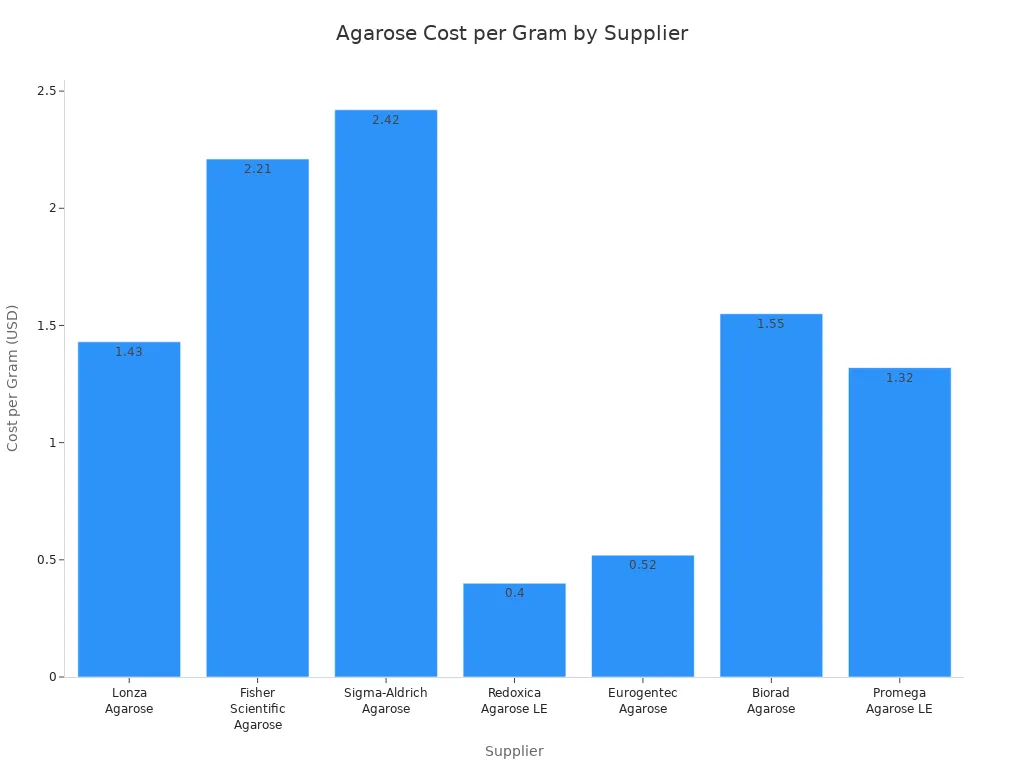
Price matters too. The chart shows agarose costs change by supplier. You can find cheap agarose for your lab. Choosing between agarose and other gels depends on what you want to study. For most DNA work, agarose is easy, safe, and works well.
Agarose is important in many science discoveries. People use it to separate DNA and look at proteins. It also helps make new medical tools. The table below shows where agarose is used in research and technology:
Application Area | Description |
|---|---|
Separates DNA and proteins for analysis | |
Biocompatibility | Safe for use with living cells and tissues |
Optical Fibers | Used in data transmission and biomedical devices |
When you learn about agarose, you help make new things possible.
FAQ
What is agar and how do you use it in science?
You use agar as a gel in labs. Agar comes from seaweed. You mix it with water and heat it. When it cools, it forms a solid gel. Scientists use agar to separate DNA and other molecules.
Can you eat agar or is it only for experiments?
You can eat agar. People use agar in foods like jelly and candy. Agar acts as a thickener. It helps foods keep their shape. You also use agar in science labs for experiments.
How does agar help you see DNA?
Agar forms a gel with tiny holes. You put DNA samples in the gel. When you run electricity through it, DNA moves. Agar separates DNA by size. You see DNA bands under UV light.
Is agar safe for you to handle?
Agar is safe for you to touch. You use agar in food and labs. Always wash your hands after handling agar. If you work in a lab, wear gloves for extra safety.
What makes agar different from other gels?
Agar has large pores. You use agar to separate big molecules like DNA. Other gels, like polyacrylamide, have smaller pores. Agar is easy to prepare and works well for many experiments.