
You have to eat more calories than your body uses every day if you want to build muscle. Sports nutrition guidelines say you should add about 250 to 500 calories over your Total Daily Energy Expenditure. This extra amount of calories helps your body make new muscle tissue. When you pay attention to the right calories intake for muscle building, you give yourself the best chance to build muscle well.
Key Takeaways
To build muscle, eat 250 to 500 calories more than your body burns each day.
Focus on a balanced diet with enough protein, carbs, and healthy fats to support muscle growth.
Track your calorie intake and adjust based on your progress to avoid gaining too much fat.
Aim for 1.8 to 2.0 grams of protein per kilogram of body weight for optimal muscle repair and growth.
Plan meals and snacks to meet your calorie and protein goals, ensuring you choose nutrient-rich foods.
Calories Intake for Muscle Building

Calories and Muscle Growth
You need to eat more than your body burns if you want to build muscle. Calories intake for muscle building means you give your body the energy it needs to repair and grow muscle tissue. When you eat in a caloric surplus, your body uses the extra energy to support muscle growth. Clinical trials show that people who eat in a caloric surplus gain more muscle mass compared to those who eat just enough to maintain their weight. The table below shows how a caloric surplus affects muscle and fat gain:
Group | Diet Type | Muscle Mass Gain | Fat Mass Gain |
|---|---|---|---|
G1 | Moderate Eucaloric | Less | Less |
G2 | Calorie Surplus | More | More |
You can see that a caloric surplus helps you build muscle faster. You need to balance your calories intake for muscle building so you do not gain too much fat.
Calorie Surplus Basics
A caloric surplus means you eat more calories than you burn each day. You should aim for a surplus of 250 to 500 calories above your Total Daily Energy Expenditure. This range supports muscle growth without adding too much fat. Calories intake for muscle building works best when you also get enough protein, carbs, and healthy fats. Your body uses the extra energy to repair muscle fibers after workouts. Some nutrients, like vitamin D, help your body use the caloric surplus for muscle instead of fat. Vitamin D lowers myostatin, a hormone that slows muscle growth. It also helps your body balance energy and build muscle.
Common Myths
Many people believe myths about calories intake for muscle building. Here are some common ones:
Eating too much protein makes you gain fat. In reality, you gain weight when your total caloric surplus is too high, not just from protein. Protein is less likely to turn into fat because your body uses more energy to digest it.
You must eat one gram of protein per pound of body weight. Research shows that muscle growth plateaus at about 0.74 grams per pound. Your needs may change based on your goals and experience.
You should focus on your total calories intake for muscle building and not just one nutrient. This approach helps you build muscle in a healthy way.
Calculating Your Calorie Needs

Find Your BMR
First, you need to know your Basal Metabolic Rate (BMR). BMR shows how many calories your body uses when you rest. This number changes with your age, sex, weight, and lean body mass. People with more muscle have a higher BMR. Doing structured resistance training helps you build lean body mass. This makes your BMR go up.
Here is a table that lists the best ways to find your BMR:
Method | Accuracy Level | Notes |
|---|---|---|
Indirect Calorimetry (IC) | Gold Standard | Most accurate method for measuring BMR, though access is limited. |
Harris-Benedict Equation | High Accuracy | Demonstrated greatest accuracy for individuals with overweight and obesity. |
Mifflin-St Jeor Equation | High Accuracy | Recommended for overweight and obese adults, relevant to modern lifestyles and body composition. |
Lazzer Equation | Low Accuracy | Showed the lowest bias for individuals with obesity (BMI > 30 kg/m2). |
Most people use the Mifflin-St Jeor or Harris-Benedict equations. These formulas use your age, sex, height, and weight. If you want the most exact number, you can go to a clinic for indirect calorimetry. This test checks the gases you breathe out to find your BMR.
Things like age and sex also change your BMR. As you get older, your BMR gets lower. Males lose BMR faster as they age than females. If you build more muscle, your BMR goes up. Strength training and eating enough proteins help keep your BMR higher.
Estimate TDEE
Once you know your BMR, you need to find your Total Daily Energy Expenditure (TDEE). TDEE is your BMR plus the calories you burn from activity. This includes walking, working out, and even small movements.
Here are the most common formulas for TDEE:
Formula Name | Description |
|---|---|
Mifflin St-Jeor Equation | A widely used formula that estimates BMR based on age, gender, height, and weight. |
Harris-Benedict Equation | Another popular formula for estimating BMR, similar to Mifflin St-Jeor but with different coefficients. |
Katch-McArdle Formula | Takes into account lean body mass and body fat, providing a more accurate estimate for lean individuals. |
You multiply your BMR by an activity factor. This factor depends on how active you are. If you do structured resistance training, you need a higher multiplier. Here is a chart with common activity multipliers:
Activity Level | Multiplier |
|---|---|
Sedentary | 12 |
Lightly Active | 13.5 |
Moderately Active | 15 |
Very Active | 16.5 |
Extremely Active | 17+ |
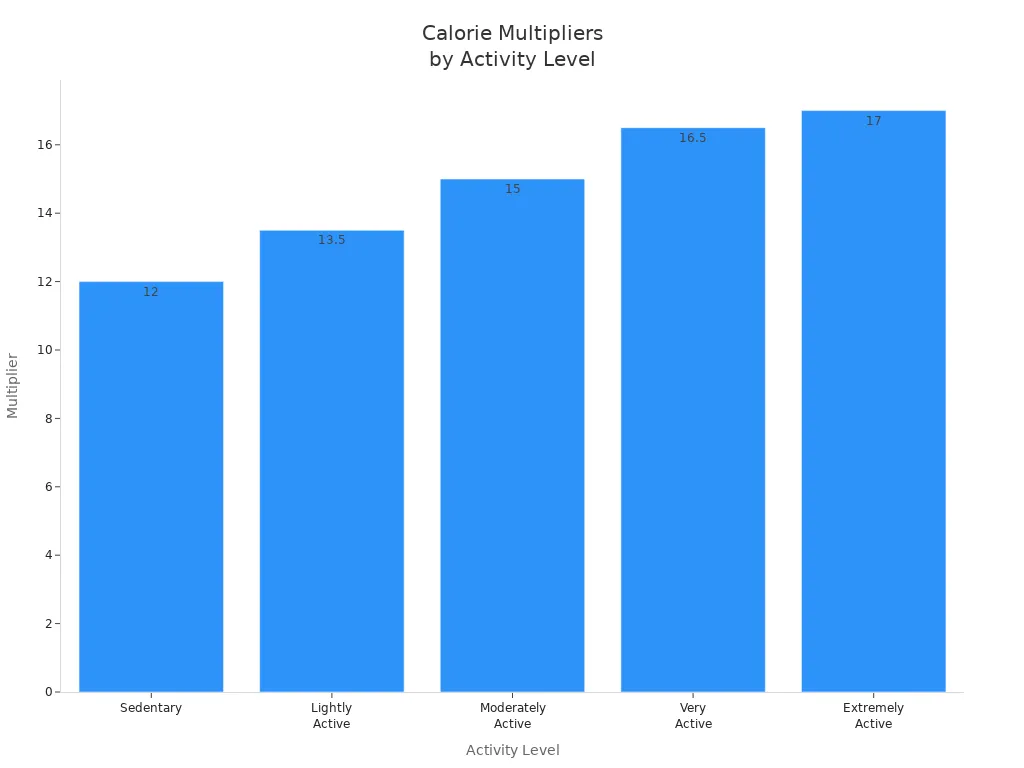
Physical activity changes your daily calorie needs a lot. On days when you train hard, you burn more calories. You may need to eat more on those days to help your muscles grow and recover.
Set Your Surplus
To build muscle, you need to eat more than your daily calorie needs. This is called a calorie surplus. Sports nutrition experts say you should eat 10% to 20% more than your TDEE. This helps you gain muscle without gaining too much fat.
Calorie Surplus | Recommendation |
|---|---|
10% | Minimum surplus |
20% | Maximum surplus |
Weight Gain Rate | Recommendation |
|---|---|
0.25% | |
0.5% | Maximum gain per week |
You can also use a simple rule. Eat about 20 calories for each pound you weigh every day if you want to gain muscle. This works for most people who exercise often.
Tip: Start with a small surplus. Watch your progress. If you gain too much fat, eat a little less. If you do not see muscle growth, eat a bit more.
A calorie surplus is important, but eating too much will not give you more muscle. Your body can only build muscle at a certain speed. Eating more than you need will just add fat.
Calorie Calculation Example
Let’s look at an example. You weigh 70 kg (about 154 pounds) and do structured resistance training three times a week. You are moderately active.
Find your BMR
Use the Mifflin-St Jeor equation. For a 70 kg person, BMR is about 1700 calories.Estimate your TDEE
Multiply your BMR by the activity multiplier for moderately active (15):
70 kg × 15 = 1050 calories from activity
1700 (BMR) + 1050 = 2750 calories (your daily calorie needs to maintain weight)Set your surplus
Add 300 calories for muscle gain:
2750 + 300 = 3050 calories per day
So, you should eat about 3050 calories each day to build muscle. Make sure you get enough protein intake and healthy carbs. This helps your muscles grow and gives you energy for workouts.
Note: Your needs may change as you gain muscle or change your activity level. Track your progress and change your daily calorie needs if needed.
Macronutrients for Muscle Building
Protein Targets
Protein is the most important nutrient for muscle building. You need enough protein to repair and grow muscle mass after each workout. The International Society of Sports Nutrition recommends the following daily protein intake for different types of exercise:
Type of Exercise | Recommended Protein Intake (g/kg/day) |
|---|---|
Endurance Exercise | 1.4 – 1.6 |
Intermittent Activities | 1.6 – 1.8 |
Strength/Power Exercise | 1.8 – 2.0 |
If you want to build muscle, aim for the higher end of this range. You should eat quality protein with every meal. High-quality protein sources include chicken, fish, eggs, dairy, and lean beef. For a lean bulk, try to get 1.8 to 2.0 grams of protein per kilogram of body weight each day. Eating protein around your workouts helps your body use it for muscle growth. Your muscles stay ready to use protein for up to 24 hours after you train.
Carbs for Energy
Carbs give you the energy you need for muscle building workouts. Your body stores carbs as glycogen in your muscles and liver. During intense training, your body uses these stores for fuel. If you do not eat enough carbs, your body may use protein for energy instead of building muscle mass. For muscle building, you should eat 5 to 7 grams of carbs per kilogram of body weight each day. This helps you recover and get stronger for your next session. Carbs also help you keep your caloric intake high enough for a lean bulk.
Highly active people need carbs to help build muscle. While carbs do not directly grow muscle, they give your body the energy to finish tough workouts.
Healthy Fats
Healthy fats are important for hormone production and muscle building. Fats help your body make testosterone and estrogen, which support muscle mass and recovery. You need fat for cell health, muscle movement, and immune function. Try to get about 30 percent of your total caloric intake from healthy fats. Good sources include olive oil, nuts, seeds, avocados, and fatty fish. Fats also help you feel full and keep your energy steady during a lean bulk.
Macro Balance
You need the right balance of macronutrients for muscle building. A good starting point is 30 percent protein, 30 percent fat, and 40 percent carbs. This balance supports muscle growth, energy, and recovery. Adjust your macros if you notice too much fat gain or not enough muscle mass. High-protein diets help you recover and feel full. Carbs give you energy for bodybuilding workouts. Fats keep your hormones in balance. Track your macros and adjust them as you gain mass or change your training.
Tip: For muscle building, focus on quality protein, enough carbs, and healthy fats. This will help you gain muscle mass without too much fat.
Bulking Meal Planning and Tracking
Structuring Meals and Snacks
You need a good plan to do well in your bulking phase. Eating three meals and two to four snacks each day helps you reach your calorie and protein goals for bulking. Studies show that eating protein at every meal helps your muscles grow better than eating most protein at night. When you plan your bulk at home, you make smarter food choices. You can use tools like MyPlate Plan to set daily food group goals. Make a grocery list and follow it. Pick foods that are low in fat and sodium. Watch how much food you put on your plate. Keep healthy snacks ready so you always have good options during your bulk.
Plan your meals at home for more control.
Use a grocery list when you shop.
Keep healthy snacks in your kitchen.
Check your portion sizes.
Pick foods that are low in fat and sodium.
Nutrient-Rich Food Choices
Choosing foods with lots of nutrients is important for a good bulk. You want foods that help you build muscle, not just add calories. Lean animal proteins like chicken, turkey, fish, eggs, and dairy give you good protein with fewer calories. Plant foods like beans, lentils, nuts, and seeds add fiber for a healthy stomach and help you feel full. Whey protein is easy to digest and helps you gain muscle. Eat healthy fats for 20-35% of your calories to help your body make hormones during your bulk. Carbohydrates help control thyroid hormones and give you vitamins and minerals. Nutrients like calcium, magnesium, and vitamin D help your muscles work and recover. Branched-chain amino acids, especially leucine, are important for gaining muscle.
Calorie Dense Food (McDonald’s Quarter Pounder + Medium Fries) | Nutrient Dense Food (Roasted Chicken, Brown Rice, Broccoli, Avocado, Greek Yogurt, Strawberries) | |
|---|---|---|
Calories | 860 | 785 |
Fat | 44 grams | 15 grams |
Saturated Fat | 15 grams | 3 grams |
Carbohydrates | 83 grams | 85 grams |
Fiber | 6 grams | 24 grams |
Protein | 35 grams | 80 grams |
Sodium | 1340 mg | 330 mg |

Using Tracking Tools
Tracking your bulk helps you stay on track. Apps like MyFitnessPal, Strongr Fastr, Cronometer, MacroFactor, and Lifesum let you log your meals and check your calories and macros. MyFitnessPal is popular because it has a barcode scanner and a big food database. You can set your own calorie and macro goals for your bulk. These tools help you keep your bulk steady and support muscle growth with the right nutrients.
Adjusting Intake and Avoiding Mistakes
You need to check your progress to avoid mistakes when bulking. Not eating enough calories can slow muscle growth. Eating too much can make you gain extra fat. Weigh yourself often to see if your weight goes up slowly. Use body fat calipers or ask a coach for better feedback. Measuring your body and taking photos also show changes during your bulk. Try to eat a little more with healthy foods, not just a lot of calories. This helps you gain muscle without too much fat. Track your calories and change your bulk if you see too much fat or not enough muscle. Keep up with your weight training and meal planning for the best results.
You can build muscle by following these steps:
Increase your daily calories by about 20%.
Eat enough protein, aiming for 1.5-2.0 grams per kilogram of body weight.
Include healthy fats for 25-30% of your calories.
Action | Benefit |
|---|---|
Track your calories | Adjust your plan for steady muscle growth |
See if you need more or fewer calories | |
Stay consistent | Build muscle over time with patience |
Stay focused on nutrient-rich foods and keep monitoring your progress. Patience and steady effort help you reach your muscle-building goals.
FAQ
How fast can you build muscle with a calorie surplus?
You can expect to gain about 0.25 to 0.5 pounds of muscle each week. Progress depends on your training, nutrition, and genetics. Track your results and adjust your calories if needed.
Do you need to eat more on workout days?
You may need extra calories on heavy training days. Your body uses more energy during intense workouts. Eating a little more helps you recover and supports muscle growth.
Can you gain muscle without gaining much fat?
Yes, you can focus on gaining lean muscle by using a small calorie surplus and eating nutrient-rich foods. Track your weight and body fat to make sure you add mostly muscle.
What happens if you eat too many calories?
If you eat too many calories, your body stores the extra energy as fat. You should aim for a moderate surplus to avoid unwanted fat gain during your muscle-building phase.
Should you change your calorie intake as you gain muscle?
Yes, you should recalculate your calorie needs as your weight and activity level change. Adjust your intake to keep building muscle without gaining too much fat.