
You can thank β-Galactosidase for changing milk sugar into galacto-oligosaccharides. These act as strong prebiotics. When you eat foods with GOS, you help feed good gut bacteria. These bacteria include Lactobacillus and Bifidobacterium. Studies show that eating GOS every day can help your gut feel better. It also helps these good bacteria grow.
Did you know? People who took GOS felt three times more gut comfort.
Optimal Temperature | GOS Bond Type | |
|---|---|---|
K. lactis | 40-50 °C | β-(1→4), β-(1→6) |
B. bifidum | 40 °C | β-(1→3) |
Key Takeaways
β-Galactosidase helps change lactose into galacto-oligosaccharides (GOS). GOS are good prebiotics that help your gut stay healthy.
Eating GOS helps good gut bacteria grow. These bacteria include Bifidobacterium and Lactobacillus. This can make digestion better and help you feel comfortable.
Making GOS works best with the right enzyme source, temperature, and pH. Changing these things can help make more GOS.
You can find GOS in many foods. Some examples are dairy products and infant formula. This makes it easy to add GOS to your diet for gut health.
Taking GOS as a supplement can help your digestion and immune system. It is helpful for people who cannot have lactose.
β-Galactosidase in GOS Synthesis
Enzyme Function
β-Galactosidase is a helpful enzyme in your body and in food science. It breaks down lactose, which is the sugar in milk. When this enzyme works on lactose, it splits it into glucose and galactose. This splitting is called hydrolysis. The galactose can then join with other sugars. This is how galacto-oligosaccharides, or GOS, are made.
Tip: If milk upsets your stomach, you might not have enough β-Galactosidase. This enzyme helps your body digest milk better.
Scientists use β-Galactosidase in labs to turn lactose into GOS. This way is very exact and works well. You get different kinds of GOS, each with special links between the sugars. For example, some GOS have Gal (β1→4) links. The enzyme does more than just break down sugars. It also helps build new ones.
Transgalactosylation
Transgalactosylation is the main step where β-Galactosidase is important. In this step, the enzyme moves a galactose from one sugar to another. Instead of only making glucose and galactose, it links galactose to other sugars. This makes longer chains called oligosaccharides.
You can see how different things change this process:
Parameter | |
|---|---|
Enzyme Concentration | 3.03 U/mL |
Initial Lactose Concentration | 500 g/L |
Temperature | 30°C |
pH | 5.08 |
Reaction Time | 4 h |
If you use the best conditions, you get more GOS and less leftover lactose. But making a lot of GOS is hard. Most of the time, you get about 30% to 40% GOS from the lactose you start with. Some special enzymes can make up to 54% GOS, but this does not happen often. There is usually some leftover lactose and other sugars at the end.
Enzymatic ways are best for making GOS because they are exact and work well.
Different enzymes give different results. Some make more GOS, while others leave more lactose.
Scientists are trying to get more GOS and make it more pure.
Note: Microbial β-Galactosidase usually makes more GOS than plant or animal enzymes. Thermophilic enzymes work better at high temperatures and can be more efficient.
When you know how β-Galactosidase works, you see why it is important for making prebiotic GOS. This enzyme breaks down sugars and also helps build special fibers that are good for your gut.
Enzyme Sources
Microbial Origins
β-Galactosidase is found in many microbes. These microbes help make a lot of GOS. The most common ones are:
Thermophilic microorganisms
These microbes give enzymes that work well in food. Lactic acid bacteria are safe and easy to grow. Thermophilic microbes can live in hot places. This helps in some factory jobs.
Enzymes from different microbes work in different ways. Some work better at certain pH or temperatures. Enzyme activity and stability can change with each type:
Parameter | Free Enzyme Activity | Immobilized Activity | Stability Across Temperatures |
|---|---|---|---|
Optimal pH | Not kept | Kept | Kept |
Storage Temperature (4°C) | Lower | Kept | Kept |
Storage Temperature (22°C) | Lower | Kept | Kept |
Storage Temperature (50°C) | Lower | Kept | Kept |
Mean Stability | 74% less | Higher | Higher |
Tip: Immobilized enzymes last longer and stay stable in heat or cold.
Bifidobacterium and Kluyveromyces
Bifidobacterium bifidum and Kluyveromyces lactis are used a lot for GOS. These two give different results.
β-Galactosidase from Bifidobacterium bifidum can make over 53.8% GOS from milk sugar. This enzyme likes to make β-1→3 bonds, which are good for dairy foods.
Kluyveromyces lactis gives less GOS, usually under 42 mg/ml. It mostly makes β-(1→3) bonds and works at a medium level.
The enzyme you pick changes the GOS you get. For example:
Enzyme Source | Types of Bonds Formed | Degree of Polymerization | Yield and Stability |
|---|---|---|---|
Bifidobacterium bifidum | β-(1→3) | High | High yield, stable |
Kluyveromyces lactis | β-(1→3) | Variable | Moderate |
Pick your enzyme by the kind and amount of GOS you want. Factories often use Bifidobacterium bifidum for more GOS and special types.
Production Process
Industrial Methods
There are different ways to make galacto-oligosaccharides (GOS) in factories. Most factories use enzymes to change lactose into GOS. They get β-Galactosidase from bacteria, yeast, or fungi. The process usually has these steps:
First, use a strong lactose solution.
Next, add β-Galactosidase. It can be free or stuck to something solid.
The enzyme changes lactose into GOS by transgalactosylation.
After the reaction, stop the enzyme, clean out color, remove minerals, and make the GOS stronger.
Some companies use whole cells. Others use only the enzyme. Both free and stuck enzymes work, but stuck ones last longer and can be used again. You get more GOS if you start with a lot of lactose. Thermostable enzymes are helpful because they work well in heat. This helps lactose dissolve and makes more GOS.
Tip: If you take out GOS as it forms, you can get even more over time.
Stirred-Tank Reactors
Factories use stirred-tank reactors (STR) to make GOS. These tanks mix everything well and keep the heat steady. You can run them in batch mode. This means you put in all the stuff at once and wait for the reaction to finish before taking out the product.
Here are some good and bad things about STRs:
Advantages of STR for GOS Production | Limitations of STR for GOS Production |
|---|---|
Can use lots of lactose, which helps make more GOS | Cooling can make lactose crystals that may block the system |
Mixes both liquid and solid lactose well | Continuous systems may make less GOS for some types |
Batch mode in STRs often gives more GOS than continuous mode. Studies show you can get about 32% GOS with both free and stuck enzymes. If you use stuck enzymes, you can use them many times and still keep over 63% of their power. This makes the process cheaper and more steady.
Note: How you set up your tank and pick your steps can change the kinds and amounts of GOS you make.
Factors Affecting Yield
Enzyme Activity
You can make more GOS by picking the right enzyme. The amount of enzyme you use also matters. Some enzymes work better than others. Bacillus circulans gives more GOS than other sources. Look at the table to see how much GOS each enzyme makes:
Enzyme Source | GOS Yield (%) |
|---|---|
Bacillus circulans | 41 |
A. oryzae | 21 |
A. aculeatus | 13 |
K. lactis | 11 |
Using more enzyme can make the reaction faster. But too much enzyme can break GOS into smaller sugars. This lowers how much GOS you get. For example, 1.5 units/ml of enzyme makes 91 g/l of GOS. But the yield is only 18%. You need to find the right amount.
β-Galactosidase works best with certain materials. Some enzymes like pure lactose. Others work well with dairy whey or cheese whey. The table shows how well each enzyme works:
Enzyme Source | Raw Material | GOS Production Efficiency (%) |
|---|---|---|
β-galactosidase from A. oryzae | Pure Lactose | |
β-galactosidase from K. lactis | Permeate | 32-46 |
Mixture of both enzymes | Cheese Whey | 32-46 |
Reaction Conditions
You can change GOS yield by changing temperature, pH, and lactose amount. The best results happen at 40 °C and pH 7.0. Using lots of lactose, like 250 g/L, helps make longer GOS chains.
Here are some things that affect GOS yield:
Factor | Description |
|---|---|
Source of Enzyme | |
Initial Lactose Concentration | More lactose helps make more GOS. |
Temperature and pH | The right temperature and pH help the enzyme work best. |
Reaction Time | You need enough time for the reaction to work well. |
Enzyme to Substrate Ratio | The amount of enzyme compared to substrate changes GOS production. |
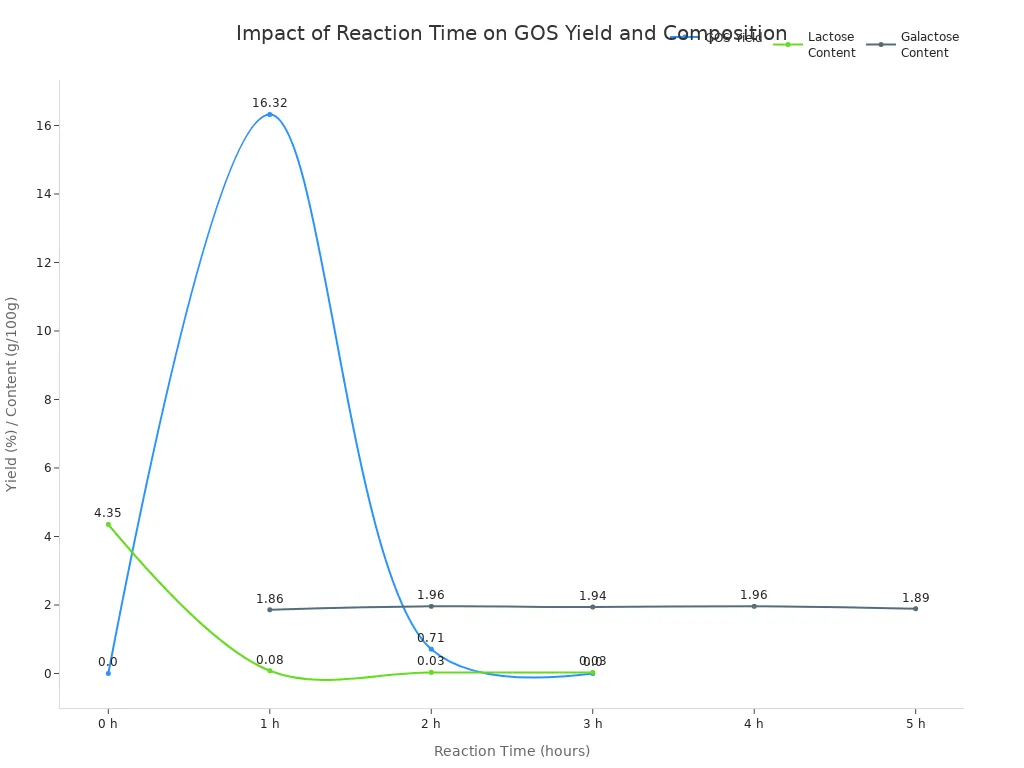
How long the reaction goes is important too. If it goes too long, the enzyme can break down GOS. This lowers the yield. The chart below shows how GOS, lactose, and galactose change over time:
Tip: You can get the most GOS by finding the best mix of enzyme, temperature, pH, and reaction time.
GOS Structure and Properties
Oligosaccharide Diversity
There are many kinds of galacto-oligosaccharides (GOS) in foods. β-Galactosidase helps make these different GOS types. The enzyme joins galactose units to form chains. These chains can be short or long. Some chains have two sugars. Others have up to eight sugars. This is called the degree of polymerization (DP).
Characteristic | Value |
|---|---|
Degree of Polymerization (DP) | 2 to 8 |
You can also find special forms like oligosaccharides from lactulose (OsLu). These include (galactosyl)n lactulose oligomers. The “n” can be any number from 2 to 10. Each GOS type has its own shape and size. Some have β-1→3 or β-1→6 bonds. These bonds matter because they help certain gut bacteria use GOS.
Oligosaccharides from lactulose (OsLu)
(galactosyl)n lactulose oligomers, with n from 2 to 10
Tip: GOS with β-1→6 bonds often help good bacteria grow faster than GOS with β-1→4 bonds.
Functional Benefits
GOS give you many health benefits because of their structure. Long chains and special bonds make GOS strong prebiotics. They do not get digested in your stomach or small intestine. Instead, they reach your colon. Good bacteria use them for food.
Criteria | Description |
|---|---|
1 | GOS resist digestion and absorption in the upper GI tract |
2 | GOS are fermented by gut bacteria |
3 | GOS help good gut bacteria grow and work better |
Different GOS structures give different effects. Chains with more sugars, like GOS4, show the highest prebiotic activity. They also have the strongest anti-inflammatory effects.
Polymerization Degree | Prebiotic Activity | Anti-inflammatory Activity |
|---|---|---|
GOS4 | Highest | Strongest inhibition of inflammation |
GOS3 | High | Moderate inhibition |
GOS2 | Moderate | Lower inhibition |
GOS1 | Lowest | Weakest inhibition |
Studies show GOS can help people with irritable bowel syndrome (IBS). You may feel less pain and more comfort in your gut. GOS also help bring back Bifidobacterium levels. This supports gut health. In animal studies, GOS help make more mucus in the gut. This protects against disease.
Study Focus | Findings | Notes |
|---|---|---|
GOS in IBS | GOS and maltodextrin used as supplements | |
Microflora Regulation | GOS helps restore Bifidobacterium in IBS | Helps by raising SCFA concentration |
Mucin Production | GOS improves mucus in rats with pancreatitis | Linked to GOS structure and amount |
Note: Because GOS have many shapes and sizes, you get many health benefits. These include better digestion and stronger gut protection.
Health Benefits

Gut Microbiota
Eating foods with galacto-oligosaccharides (GOS) helps your gut. These sugars go to your colon without being digested. Good bacteria, like Bifidobacterium and Lactobacillus, use GOS for food. Adding GOS to your meals helps these bacteria grow. Even a little GOS can help a lot. One study showed women who took 2 grams of GOS each day had more Bifidobacterium. Their gut bacteria changed in a good way.
Findings | Details |
|---|---|
Bifidobacterium Increase | GOS made Bifidobacterium grow more than in the placebo group. |
Beneficial Bacteria Increase | GOS helped Lactobacillus and Bifidobacterium grow in the gut. |
Alleviation of Lactose Intolerance | GOS helped lower lactose intolerance problems. |
Gut Health Improvement | GOS helped with inflammation, antioxidants, and gut barrier strength. |
Eating GOS can change how your body uses food. People who took GOS ate fewer carbs. This helped Bifidobacterium grow even more. Your gut gets stronger and healthier with these changes.
Tip: To help your gut, try foods or supplements with β-Galactosidase. This enzyme makes GOS that feed good bacteria.
Immune Support
GOS helps your immune system too. These sugars do more than feed good bacteria. They help your body fight germs. GOS can stop bad bacteria from sticking to your gut wall. This keeps your gut strong and lowers infection risk.
Here is what scientists found about GOS and your immune system:
Evidence Description | Findings | Implications |
|---|---|---|
GOS promotes growth of beneficial bacteria | Supports immune system through gut bacteria | |
GOS inhibits pathogenic bacteria adherence | GOS makes the gut wall stronger | Lowers infection risk and helps immune responses |
GOS interacts with immune cells | GOS helps release IL-10 and activates NK cells | Helps control immune responses and lowers swelling |
GOS shows immunomodulatory effects | GOS helps Th1-type responses and gut immune growth | Shows GOS may help early life immune support |
Some studies tested GOS in different groups. In foals, GOS lowered swelling but did not change overall immunity. In older adults, GOS raised good bacteria but did not change immune markers. You may get the most help from GOS when your gut needs extra care.
Study Title | Population | Key Findings |
|---|---|---|
Effects of orally administered galacto-oligosaccharides on immunological parameters in foals: a pilot study | Foals | |
Galacto-oligosaccharides supplementation in prefrail older and healthy adults | Older and healthy adults | GOS raised good bacteria but did not change immune function or stress markers. |
Note: GOS works best when you use it often. You help your gut and immune system together.
Applications
Food Industry
You see galacto-oligosaccharides (GOS) in many foods today. Food makers add GOS to help your gut and boost nutrition. GOS works well in many products because it stays stable in heat and acid. You find GOS in foods like:
Infant formula
Dairy products (yogurt, milk drinks)
Baked goods (bread, cookies)
Health drinks and smoothies
Functional foods and snacks
In 2024, the food and beverage sector made up over 59.5% of the global GOS market. This shows that more people want foods that help their gut. You notice GOS most in infant formula. Scientists use GOS to make formula closer to human milk. This helps babies build strong gut bacteria and a healthy immune system.
You also see GOS in plant-based foods. More people have lactose intolerance now. Plant-based GOS gives you the same benefits without milk. The food and beverage industry will keep growing with GOS through 2034. You will find GOS in more dairy, baked goods, and drinks.
Tip: When you choose foods with GOS, you help your gut and support your immune system.
Supplements
You can take GOS as a supplement if you want extra support for your gut. GOS supplements come as powders, chewables, or capsules. Many studies show that GOS helps your digestive health. Look at the table below to see what researchers found:
Study | Findings |
|---|---|
Babakhani et al. (2025) | 5.5 g/day GOS raised Bifidobacterium and Bacteroides in the gut. |
Lee et al. (2024) | 2 g/day GOS improved bowel movements and raised good bacteria. |
Johnstone & Kadosh (2025) | 5.5 g/day GOS lowered negative feelings in healthy children. |
Hu et al. (2024) | GOS is safe for adults at 5–20 g per day. |
You see GOS supplements help both children and adults. One study found that GOS helped children with autism by raising Bifidobacterium and easing stomach problems. Another study showed that GOS in a synbiotic improved blood sugar in people with type 2 diabetes.
You can add GOS supplements to your daily routine. They help your gut, support your mood, and may even help control blood sugar.
Note: Always check with your doctor before starting new supplements, especially for children or if you have health concerns.
Future Trends
Enzyme Engineering
Scientists are making new changes to β-Galactosidase. They use enzyme engineering to change how the enzyme works. This helps make more GOS and less extra sugar. Some enzymes can work well in hot or sour places. These new enzymes help factories use less energy and make GOS faster.
Here are some ways enzyme engineering helps:
Improved Yield: You get more GOS from the same lactose.
Better Stability: Enzymes last longer and work in hard places.
Custom GOS: Scientists can make enzymes for special GOS types.
Tip: Enzyme engineering can help make GOS like the sugars in human milk. This is good for babies and people with special diets.
Some new enzymes can also work with plant-based lactose. This helps people who do not eat dairy foods.
Product Innovation
You will soon see GOS in more foods and supplements. Companies use new tools to put GOS in snacks, drinks, and pet food. You can pick from many products for your taste and health.
Product Type | Example Uses | Benefit for You |
|---|---|---|
Dairy Alternatives | Plant-based milk, yogurt | Gut health for all diets |
Functional Snacks | Bars, cookies, cereals | Easy way to get prebiotics |
Beverages | Smoothies, juices, teas | Refreshing and healthy |
Supplements | Powders, gummies, capsules | Simple daily support |
You may also find GOS mixed with other prebiotics or probiotics. This mix is called a synbiotic. Synbiotics give your gut even more help.
Note: Look for new labels like “prebiotic fiber” or “supports gut health.” These mean GOS is inside.
You will have more choices and better products as science grows. GOS will help you and your family stay healthy in new ways.
When you eat foods with β-Galactosidase, you help your gut. This enzyme lets factories make GOS faster and better. Choosing the best enzyme and fixing the process can give more GOS and better quality. New science will soon bring you even more good prebiotics for your meals.
FAQ
What is β-Galactosidase?
β-Galactosidase is an enzyme. You use it to break down lactose into smaller sugars. Factories use it to make galacto-oligosaccharides (GOS), which help your gut stay healthy.
Are GOS safe for everyone?
Most people can eat GOS safely. You may feel mild gas or bloating at first. If you have allergies or special health needs, talk to your doctor before trying new foods or supplements.
How do GOS help my gut?
GOS feed good bacteria in your gut. These bacteria help you digest food better. You may notice less stomach discomfort and better bowel movements when you eat foods with GOS.
Can I get GOS from regular foods?
You find GOS in some dairy products, infant formula, and foods with added prebiotics. You can also take GOS as a supplement. Always check the label for “GOS” or “prebiotic fiber.”
Do GOS help with lactose intolerance?
Yes! GOS can help you if you have trouble digesting lactose. They support good bacteria that break down lactose. You may feel less bloating and discomfort after eating dairy.