
Your cells need energy to work well, and L-Aspartic Acid helps make that happen. This amino acid takes part in protein metabolism and plays a direct role in your body’s energy cycle, called the Krebs cycle. When you eat foods with protein, your body uses L-Aspartic Acid to keep your cells fueled. You can support your health by understanding how this process works.
Key Takeaways
L-Aspartic Acid is important for making proteins. It helps your body build and fix muscles.
This amino acid is very important in the Krebs cycle. It changes into oxaloacetate to help make energy.
Eating foods with lots of protein like eggs, meat, and soy gives you enough L-Aspartic Acid for good health.
L-Aspartic Acid helps move nitrogen in your body. It helps your body get rid of extra nitrogen using the urea cycle.
There are supplements, but most people get enough L-Aspartic Acid from eating a healthy diet.
L-Aspartic Acid in Metabolism
Protein Synthesis
Amino acids help your body make proteins. L-Aspartic Acid is one of these amino acids. Your DNA has codes called codons. These codes tell your body to add aspartic acid to new proteins. The L-form is the kind your body uses. This amino acid helps start and control protein making. Without it, your body cannot make proteins well. You need proteins for growth, repair, and daily life.
Amino Acid Catabolism
Your body breaks down proteins and amino acids like L-Aspartic Acid. This makes some important byproducts. The table below shows what these byproducts are and what they do:
Metabolic Byproduct | Description |
|---|---|
Fumarate | Comes from argininosuccinate and keeps the carbon part from L-Aspartic Acid. |
Arginine | Made from argininosuccinate and keeps the nitrogen from L-Aspartic Acid. |
Urea | Forms when arginine breaks down and helps remove extra nitrogen. |
Malate | Comes from fumarate and can turn into oxaloacetate to help make glucose. |
Oxaloacetate | Can change back to L-Aspartic Acid or help make glucose. |
Your body uses these byproducts in different ways. Urea helps get rid of extra nitrogen. Malate and oxaloacetate help make energy and glucose. This shows how L-Aspartic Acid links protein breakdown to making energy.
Nitrogen Transport
Your body must move nitrogen safely. L-Aspartic Acid helps with this job. It can turn into asparagine, which stores and carries nitrogen. This is important because too much nitrogen can hurt you. L-Aspartic Acid is also important in the urea cycle. It gives one nitrogen atom to make urea. Your body removes urea as waste. Here is how this works:
It joins with citrulline to form argininosuccinate in the urea cycle.
Urea is made at the end and helps remove extra nitrogen.
L-Aspartic Acid also helps in the malate–aspartate shuttle. This moves energy and nitrogen inside your cells, mostly in the mitochondria. The shuttle helps your cells make energy and keeps your metabolism working well.
Tip: L-Aspartic Acid is part of many pathways. These include urea making, the purine-nucleotide cycle, the malate–aspartate shuttle, gluconeogenesis, and neurotransmission. This makes it very important in your metabolism.
Krebs Cycle and Energy

Entry Points
You help your cells get energy by eating food. When you eat protein, your body breaks it into amino acids. L-Aspartic Acid is one of these amino acids. It can join the Krebs cycle by a process called transamination. In this process, L-Aspartic Acid turns into oxaloacetate. Oxaloacetate is needed to start the cycle. This step helps your body keep making energy when you need it.
Transamination changes L-Aspartic Acid into oxaloacetate. Oxaloacetate is very important in the Krebs cycle.
This process is called anaplerosis. It helps refill the cycle with needed molecules so your cells keep making energy.
Your body can also make aspartic acid from oxaloacetate. This two-way process helps your body balance energy and amino acids.
Oxaloacetate Formation
Your body uses enzymes to change L-Aspartic Acid into oxaloacetate. One enzyme is called cAST. It helps L-Aspartic Acid and 2-OG turn into oxaloacetate and glutamate. This happens inside your cells, mostly in the mitochondria.
L-Aspartic Acid can also join the urea cycle. In this cycle, it helps make fumarate. Fumarate then turns into malate. Malate can change back into oxaloacetate in the cytosol. These steps help your cells get enough oxaloacetate for energy.
Making oxaloacetate from L-Aspartic Acid is an anaplerotic reaction. This means it refills the Krebs cycle with needed parts.
This process helps the cycle use acetyl-CoA better, especially when you need more energy.
More oxaloacetate lets your cells make more citric acid. This helps your cells make more ATP.
ATP Generation
You need ATP for things like moving and thinking. The Krebs cycle is the main way your cells make ATP. L-Aspartic Acid helps this in two ways.
First, it makes oxaloacetate to keep the Krebs cycle going. This lets your cells turn nutrients into energy. Second, L-Aspartic Acid is part of the malate-aspartate shuttle. This shuttle moves energy from the cytoplasm to the mitochondria, where ATP is made.
L-Aspartic Acid is important for the malate-aspartate shuttle. This shuttle helps make ATP in mitochondria.
It helps move reducing equivalents from cytosolic NADH to mitochondrial NAD+. This makes energy production work better.
The shuttle is very important during glycolysis. It helps your cells get the most energy from glucose.
Note: Having enough L-Aspartic Acid helps your mitochondria stay healthy and make energy. This is important for your muscles, brain, and all your cells.
Cellular Functions
Nucleotide Synthesis
Your body needs nucleotides for DNA and RNA. L-Aspartic Acid helps your cells make these molecules. It helps keep redox reactions balanced. This keeps your cells healthy. L-Aspartic Acid helps make purine and pyrimidine bases. These bases are the main part of every nucleotide.
L-Aspartic Acid helps keep redox balance in cells.
Your body uses it to make bases for DNA and RNA.
Your cells use special steps to make these bases. The table below shows how L-Aspartic Acid works in each step:
Pathway Type | Role of L-Aspartic Acid |
|---|---|
Pyrimidine Biosynthesis | Helps change carbamoyl phosphate to carbamoylaspartate, which is the first step. |
Purine Biosynthesis | Starts the process to turn IMP into AMP. |
L-Aspartic Acid is used in a six-step process to make pyrimidines from amino acids. This process is similar in many living things.
mTORC1 Activity
Your cells need to sense nutrients to grow. The mTORC1 pathway acts like a sensor. L-Aspartic Acid helps signal this pathway. If you have enough L-Aspartic Acid, your cells know they can make new proteins and nucleotides. This helps your body repair and grow. If you do not have enough, your cells slow down growth.
Tip: Keeping L-Aspartic Acid levels steady helps your cells respond to changes in nutrients.
Lipogenesis
Your body stores extra energy as fat. This is called lipogenesis. L-Aspartic Acid helps with this process. Some tissues use NAA, which comes from L-Aspartic Acid, to make fats. For example, mammary glands can turn NAA into fats. Brown fat tissue also uses L-Aspartic Acid to make and store fats. NAA can store acetate. Your body can turn acetate into acetyl-CoA. Acetyl-CoA is needed to make new fats.
Evidence Description | Findings |
|---|---|
NAA metabolism in tissues | Tissues like mammary glands turn NAA into fats. |
Expression in brown adipose tissue | Brown fat uses L-Aspartic Acid for making fats. |
Role in acetyl-CoA synthesis | NAA stores acetate, which turns into acetyl-CoA for making new fats. |
You need L-Aspartic Acid for healthy fat metabolism and energy storage. This helps your body stay balanced and ready when you need more energy.
Health and Nutrition

Dietary Sources
L-Aspartic Acid is found in lots of foods. Both animal and plant proteins have it. If you eat eggs, dairy, meat, or fish, you get L-Aspartic Acid. Soy protein is a plant source with high levels. The table below shows how much is in some foods:
Food Source | L-Aspartic Acid (g per 100g) |
|---|---|
Soy protein isolate, potassium type | 10.203 |
Soy protein isolate | 10.203 |
Egg, white, dried, stabilized, glucose reduced | 9.139 |
Egg, white, dried | 8.253 |
Egg, white, dried, powder, stabilized, glucose reduced | 7.291 |
Soy protein concentrate, produced by alcohol extraction | 7.249 |
Soy protein concentrate, produced by acid wash | 7.249 |
Seal, bearded (Oogruk), meat, dried (Alaska Native) | 6.877 |
Egg, white, dried, flakes, stabilized, glucose reduced | 6.806 |
Beverages, Protein powder soy based | 6.576 |
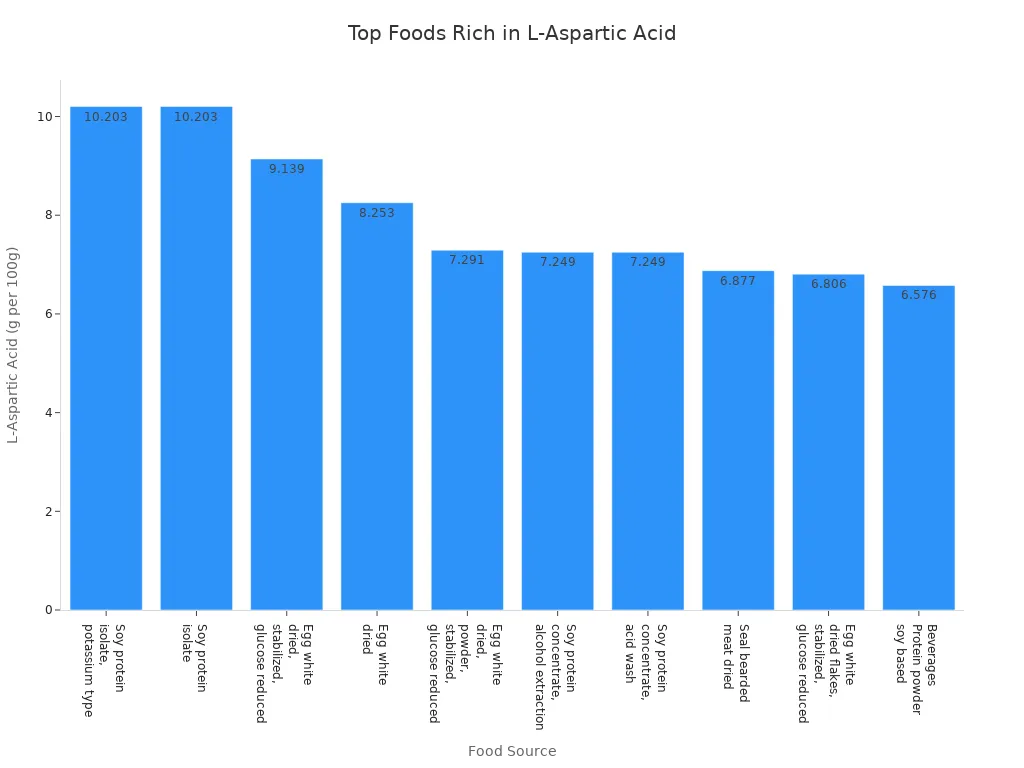
You also get L-Aspartic Acid from beef, chicken, turkey, salmon, tuna, and dairy. Most people eat about 6.54 grams each day if they follow a Western diet.
Supplement Use
Some people take L-Aspartic Acid supplements for energy or muscle growth. These supplements are found in sports nutrition products. If you eat enough protein, you usually get enough L-Aspartic Acid. Supplements may help if you need more, but talk to your doctor first.
Tip: Eating many protein-rich foods gives you enough L-Aspartic Acid. You do not always need supplements.
Risks
Too much L-Aspartic Acid can cause problems. You might feel bloated or have gas and diarrhea. Some people feel restless, irritable, or have trouble sleeping. High doses can hurt your kidneys. Allergic reactions like itching, rash, swelling, dizziness, or trouble breathing can happen. L-Aspartic Acid may also interact with some medicines.
Nervous system problems (restlessness, irritability, insomnia)
Kidney strain or damage
Allergic reactions (itching, rash, swelling, dizziness, trouble breathing)
Possible interactions with medicines
If you notice side effects, stop using supplements and ask your doctor for help.
You help your body by learning about L-Aspartic Acid. This amino acid helps you get energy and build proteins. It also keeps your cells healthy.
L-Aspartic Acid is part of the citric acid cycle for energy.
It helps make important molecules in your body.
The enzyme AST uses it to help your muscles and liver work.
Function | Description |
|---|---|
Helps your muscles grow and heal. | |
Hormone Regulation | Helps keep your hormones balanced for good health. |
Fertility Effects | May help sperm health and male fertility if you take enough. |
Remember, eating many different foods gives you the L-Aspartic Acid you need to stay healthy.
FAQ
What does L-Aspartic Acid do in your body?
L-Aspartic Acid helps your body make proteins and energy. You use it to build muscles, support your brain, and keep your cells healthy. It also helps remove extra nitrogen and supports DNA and RNA production.
Can you get enough L-Aspartic Acid from food?
Yes, you can. Foods like eggs, meat, fish, and soy give you plenty of L-Aspartic Acid. If you eat a balanced diet with protein-rich foods, you usually meet your needs.
Should you take L-Aspartic Acid supplements?
Most people do not need supplements if they eat enough protein. You may see supplements in sports stores, but always talk to your doctor before using them.
Is L-Aspartic Acid safe for everyone?
L-Aspartic Acid is safe for most people when you get it from food. High doses from supplements can cause stomach upset or other side effects. If you feel unwell, stop taking it and ask your doctor.
How does L-Aspartic Acid help with energy?
You use L-Aspartic Acid to make oxaloacetate, which keeps your energy cycle running. It also helps move energy inside your cells. This lets your body make more ATP, the main energy source for your muscles and brain.