A successful pectin gummy recipe depends on more than the amount of gelling agent. Pectin grade, sugar and syrup composition, final solids, acidity and depositing conditions all need to work together.
This guide explains a reference formulation using HSC105 high-methoxyl (HM) slow-set pectin, with approximately 1.8% pectin, a pH of 3.2–3.4 and a depositing temperature around 95°C. It provides a starting point for manufacturers developing fruit-flavored gummy candy.
Why Use Slow-Set HM Pectin for Gummies?
Pectin is a plant-derived gelling ingredient commonly associated with apples and citrus fruits. Conventional HM pectin forms gels in an acidic, high-solids sugar system.
Setting behavior matters during manufacturing. A slow-set grade can provide a longer working window than a rapid-set grade under comparable conditions, helping manufacturers coordinate mixing and mold filling. Actual setting time still depends on the selected grade and formulation.
For gummy production, select pectin by its setting characteristics and application specification, rather than treating every pectin powder as interchangeable.
Pectin Gummy Reference Formula
The following quantities are taken from the HSC105 application guide.
| Ingredient | Quantity | Formulation note |
|---|---|---|
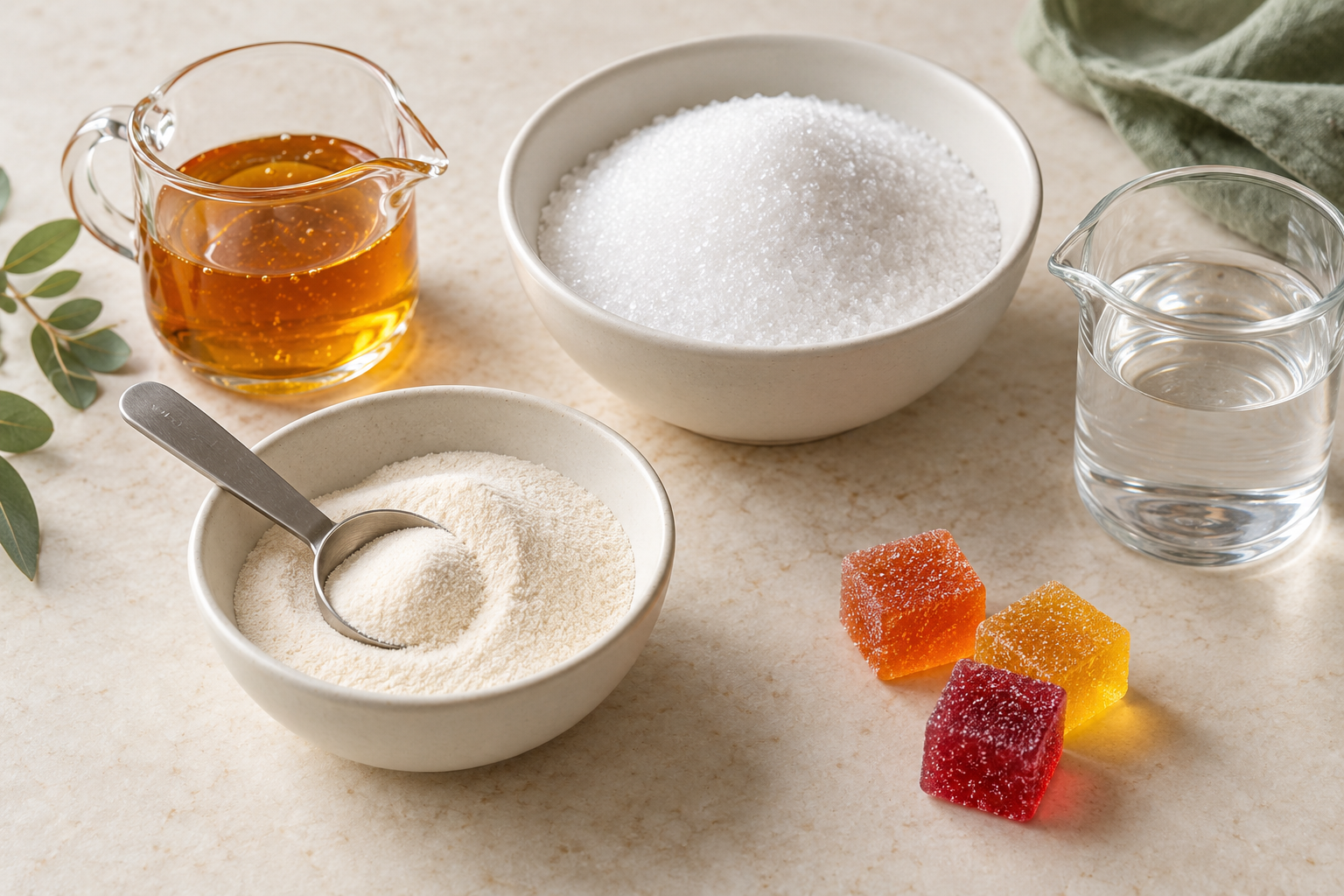
| HSC105 slow-set HM pectin | 18 g | 1.8% of an approximately 1,000 g finished batch |
| White granulated sugar | 448 g | Reserve approximately 90 g for the pectin preblend |
| Maltose syrup | 420 g | DE 42; 75% solids |
| Water | 180 g | Initial water addition |
| Flavor | 0.5 g | Match the intended flavor profile |
| Color | 0.5 g | Match the intended appearance |
| Sodium citrate | 3.5 g | Include in the dry preblend |
| Citric acid solution | 15 g | 50% concentration; adjust according to measured pH |
Reference batch conditions
| Parameter | Value in the application guide |
|---|---|
| Total input weight | Approximately 1,085 g |
| Final cooked batch weight | Approximately 1,000 g |
| Solids content | 78% |
| Final pH | 3.2–3.4 |
| Depositing temperature | Approximately 95°C |
| Suggested pectin trial range | 1.8–2.0% |
The listed ingredients total 1,085.5 g. Cooking removes water, which explains why the input weight exceeds the stated final yield. The guide’s yield and 78% solids value are approximate reference conditions; confirm the solids measurement basis and measured endpoint during trials.
The 15 g acid addition is a starting quantity, not a substitute for measuring pH.
How to Make Pectin Gummies
1. Prepare the Pectin and Sugar Preblend
Mix the 18 g pectin, 3.5 g sodium citrate and approximately 90 g sugar until evenly distributed.
Take this sugar from the listed 448 g total. The sugar remaining for the cooking stage is approximately 358 g.
Dry preblending helps distribute the pectin when it enters the water and reduces the risk of powder clumps.
2. Disperse and Dissolve the Pectin
The HSC105 guide specifies water at approximately 50°C for the initial addition.
Slowly add the dry preblend to the stirred water. Continue mixing until the pectin is thoroughly dissolved, following the grade’s specified heating and hydration procedure.
Treat 50°C as the initial water temperature in this particular reference process. Confirm the dissolution procedure when using another pectin grade.
3. Add Syrup and the Remaining Sugar
Add the 420 g maltose syrup and approximately 358 g remaining sugar.
Cook the mixture to the required solids endpoint. Record final batch weight and measured solids so that evaporation can be controlled consistently from one trial to the next.
The approximately 95°C value in this recipe is the depositing temperature, not the cooking endpoint.
4. Add Flavor and Color
Add the flavor and color after the concentration stage, as shown in the reference guide. Mix until the candy mass is uniform.
Confirm the addition conditions with the selected flavor and color specifications, especially when changing materials.
5. Adjust the pH with Citric Acid Solution
Add the prepared 50% citric acid solution near the end of the process and adjust the mixture to pH 3.2–3.4.
Use the listed 15 g as an initial reference. Measure pH using a consistent sampling method, and adjust the quantity according to the actual result.
Adding acid late helps preserve the working window before depositing. Once acid is incorporated, coordinate mixing and filling to limit the risk of premature gelation.
6. Deposit at Approximately 95°C
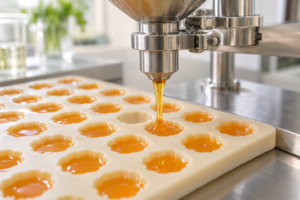
Deposit the candy mass into molds at approximately 95°C, as specified in the HSC105 guide.
Let the gummies cool and set, then assess mold filling, release and texture under consistent conditions. Establish any subsequent conditioning or drying requirements through trials; the supplied guide does not specify these stages.
How Much Pectin Should You Use?
The application guide recommends 1.8–2.0% pectin, adjusted to the required texture and gelation speed.
For an approximately 1,000 g final cooked batch, this corresponds to:
| Pectin addition | Pectin quantity |
|---|---|
| 1.8% | 18 g |
| 1.9% | 19 g |
| 2.0% | 20 g |
Within this reference system, the guide states that increasing pectin produces a firmer texture and faster gelation.
Compare these levels while keeping the syrup specification, final solids, pH and evaluation conditions consistent. If final cooked yield changes, recalculate the addition percentage.
Troubleshooting Pectin Gummy Production
Use the following checks to organize formulation trials. A symptom may have more than one cause.
| Observation | Checks to make |
|---|---|
| Pectin clumps or an uneven mixture | Check dry preblending, addition rate, mixing and complete dissolution |
| Gummies are softer than intended | Verify pectin dosage, measured solids, pH and hydration before changing the recipe |
| The mass gels before molds are filled | Review acid-addition timing, holding time, depositing conditions and pectin setting grade |
| Gummies are firmer than intended | Compare the pectin level and cooking endpoint with the reference conditions |
Change one variable at a time and evaluate each batch after the same setting period. This makes the results easier to interpret.
Frequently Asked Questions
Can I Replace Gelatin with Pectin at the Same Dosage?
A direct substitution should be evaluated through reformulation. Pectin and gelatin have different gelation behavior and eating textures. This reference formula is designed around HM pectin, sugar, syrup and controlled acidity.
Can This Formula Be Used for Low-Sugar Gummies?
Reducing sugar changes the gelation system. This is a conventional sugar-and-syrup reference recipe. A reduced-sugar version needs a suitable pectin grade and a separately tested formulation.
Why Is Citric Acid Added Near the End?
Acidity is part of the HM pectin gelation system. Late acid addition helps manufacturers manage the time available for mixing and depositing before the candy mass sets.
Does 1.8% Mean 1.8% of the Initial Ingredient Weight?
Here, 18 g corresponds to 1.8% of the approximately 1,000 g final cooked batch. It is approximately 1.66% of the 1,085.5 g initial ingredient charge. Keep the dosage basis explicit when scaling the recipe.
Discuss Your Pectin Gummy Formulation with Anrui Bio
Looking for a pectin grade for gummy candy production? Share your sugar and syrup system, target pH and solids, desired texture, depositing method and estimated purchase quantity.
Explore our food thickeners and hydrocolloids or contact Anrui Bio to discuss grade matching, sample availability and product-specific technical documents.
Editorial source notes — separate from the article body
- The ingredient quantities, product code and numerical reference conditions come from the supplied HSC105 application-guide image.
- General HM pectin behavior, dissolution and setting-grade background: Cargill — Pectin.
- Confectionery gelation, pH control and pre-gelling background: Cargill — Pectin confectionery technical article.
- Application and grade-selection background: Herbstreith & Fox — Confectionery.
- SEO title approach: Google Search Central — Title links.
Editorial check before publication: With 75%-solids syrup, the listed sucrose and syrup contribute about 763 g dry matter. Adding the other ingredients’ solids places the estimated total near 79% at a 1,000 g yield, depending on their actual dry matter. Retain 78% as the supplier’s reference value, and confirm its measurement basis and the final yield against current product specifications.