
You have a special problem when you try to change blue in the Natural Color Shift. Blue pigments are not common in nature. Scientists have a hard time finding blue colorants that stay stable in food and products. There are tough rules from regulators, especially for natural blue choices. Both companies and buyers notice these problems.
Key Takeaways
Blue pigments are hard to find in nature, so it is tough to get them for food and products. Natural blue colors can change when they are in light, heat, or different pH, which makes them less stable. The FDA wants to stop using synthetic dyes by 2026, so companies need to look for natural choices. New things like spirulina and butterfly pea are good options for blue pigments that stay stable. Picking products with natural blue colors helps people make healthier and greener choices.
Science of Blue Pigments

Blue Scarcity in Nature
You might notice that blue is rare in the natural world. Most plants and animals do not make true blue pigments. When you see blue in nature, it often comes from special tricks of light or from rare chemicals. For example, blueberries and cornflowers get their blue color from anthocyanins. These are water-soluble compounds that can look blue, red, or purple. The color changes with the pH level around them. This means the blue you see can fade or shift if the environment changes.
Blue pigments in plants are mostly anthocyanins.
Anthocyanins change color with pH, so blue shades are not stable.
Blue is much less common than green, yellow, or red in nature.
You can see how this scarcity makes blue a big challenge during the Natural Color Shift. Companies struggle to find enough natural blue sources for foods and products.
Color Shift and Metamerism
Blue colors do not always stay the same. You might see a blue gemstone look different under sunlight and indoor lights. This effect is called metamerism. Sapphires, fluorite, and alexandrite are good examples. Alexandrite can look blue-green in daylight but turn red under a lamp. This happens because the chemical structure of blue pigments reacts to different types of light.
Note: Metamerism makes it hard to keep blue colors looking the same in every setting. This is a big problem for food and product makers during the Natural Color Shift.
Natural blue pigments also shift color when exposed to heat, light, or changes in pH. This makes it hard for you to get a stable blue color in foods, drinks, or packaging.
Blue vs. Other Colors
You might wonder why blue is so much harder to replace than other colors. The answer lies in chemistry. Blue pigments have more complex structures than red, yellow, or green pigments. Take a look at this table:
Pigment Type | Key Components | Color Characteristics |
|---|---|---|
Egyptian Blue | Cuprorivaite, SiO2 polymorphs, wollastonite | Deep blue, changes with composition |
Other Blue Pigments | Varies, often less complex than Egyptian blue | Less vibrant, simpler structures |
Red, Yellow, Green | Various organic and inorganic compounds | Usually less complex than blue pigments |
Blue pigments like anthocyanins are sensitive to their environment. They can fade or change color if you heat them, change the pH, or expose them to light. This is not as much of a problem for red, yellow, or green pigments. When companies try to replace synthetic blue dyes, they face many problems:
Natural blue pigments can break down with heat, pH changes, or light.
Some natural blues change the taste of foods, so recipes need to change.
The FDA wants companies to stop using synthetic dyes by 2026, which adds pressure.
You can see why the Natural Color Shift is especially tough for blue. Companies need new ways to keep blue colors bright and stable. You might notice that blue foods and products look different or taste different as a result.
Natural Color Shift Challenges
FDA and Regulatory Barriers
There are strict rules for using natural blue pigments in food and products. The FDA has tough standards for color additives. You must follow the Federal Food, Drug, and Cosmetic Act. The FDA puts color additives into two groups. Some need certification, and some do not. Each colorant has a limit for how much you can use. You cannot use more than the allowed amount. For example, FD&C Red No. 40 can only be used up to 200 mg/kg in some drinks.
Regulatory Aspect | Details |
|---|---|
Regulatory Act | Federal Food, Drug, and Cosmetic Act |
Classification of Color Additives | Two groups: those subject to certification and those exempt from certification |
Usage Limits | Each approved colorant must meet strict usage limits, with maximum allowable concentrations |
Example of Certification | FD&C Red No. 40 has specific limits, such as 200 mg/kg in certain beverages |
There are also special rules for natural colors. The FDA approves natural colors under 21 C.F.R. pt. 73. Synthetic colors get approval under Part 74. Only sodium copper chlorophyllin is allowed as a green color in Part 73. You can use it up to 0.2% in citrus dry drink mixes.
Regulatory Aspect | Details |
|---|---|
Natural Colors Regulation | Cleared under 21 C.F.R. pt. 73 (Part 73) |
Synthetic Colors Regulation | Cleared under Part 74 |
Example of Natural Color | Sodium copper chlorophyllin is the only green color permitted in Part 73, cleared at up to 0.2% in citrus-based dry beverage mixes |
The FDA wants companies to stop using synthetic dyes by 2026. You need to find natural pigments to use instead. You must give full data to support new petitions for natural colors. This makes the Natural Color Shift harder for blue pigments. You must show that new colors are safe and work well.
FDA Initiative | Description |
|---|---|
Phase Out Synthetic Dyes | Encourages food companies to eliminate petroleum-based synthetic dyes by the end of 2026. |
Shift to Natural Alternatives | Promotes the exploration of natural pigments as replacements for synthetic dyes. |
Regulatory Approval | Companies must provide comprehensive data to support new natural color additive petitions. |
Stability and Shelf Life
There are many problems with natural blue pigments. These pigments break down easily. Light makes the color fade. Ultraviolet rays destroy the pigment’s structure. Washing can break chemical bonds and cause color loss. Changes in pH make the color shift. Microbes can ruin the color for good. Oxygen, heat, and humidity make pigments break down faster. Textile additives can react with pigments and change the color.
Washing and detergents cause color loss.
pH changes make colors shift.
Microbes ruin the color.
Oxygen makes breakdown faster.
Textile additives cause color changes.
Heat also affects how long pigments last. High heat breaks down pigments. Non-thermal methods can help keep color. Oxygen makes pigments fade faster. Vacuum packaging helps protect the color.
High heat breaks down pigments.
Non-thermal methods help keep color.
Oxygen makes pigments fade faster.
Vacuum packaging helps protect color.
Natural blue pigments do not last as long as synthetic ones. Products with natural blue colors have a shorter shelf life. You must store them carefully to keep the color.
Flavor and Performance Issues
Natural blue pigments can change how food tastes. Some pigments make food taste bitter or earthy. You must change recipes to hide these flavors. Synthetic blue dyes do not change taste. Natural blue pigments can also change how products work. They fade in sunlight. Outdoor products lose color fast. Washing makes color fade. High heat during washing makes color loss worse.
Natural blue pigments fade in sunlight.
Washing makes color fade.
High heat makes color loss worse.
In a big study, people thought brighter colors meant better taste and more flavor in 89% of products. This happened even when they did not taste the food. How food looks changes how people think it tastes.
You must balance color, taste, and how products work. The Natural Color Shift makes this balance harder. You need new ways to keep products looking and tasting good.
Innovations and Solutions
New Blue Sources
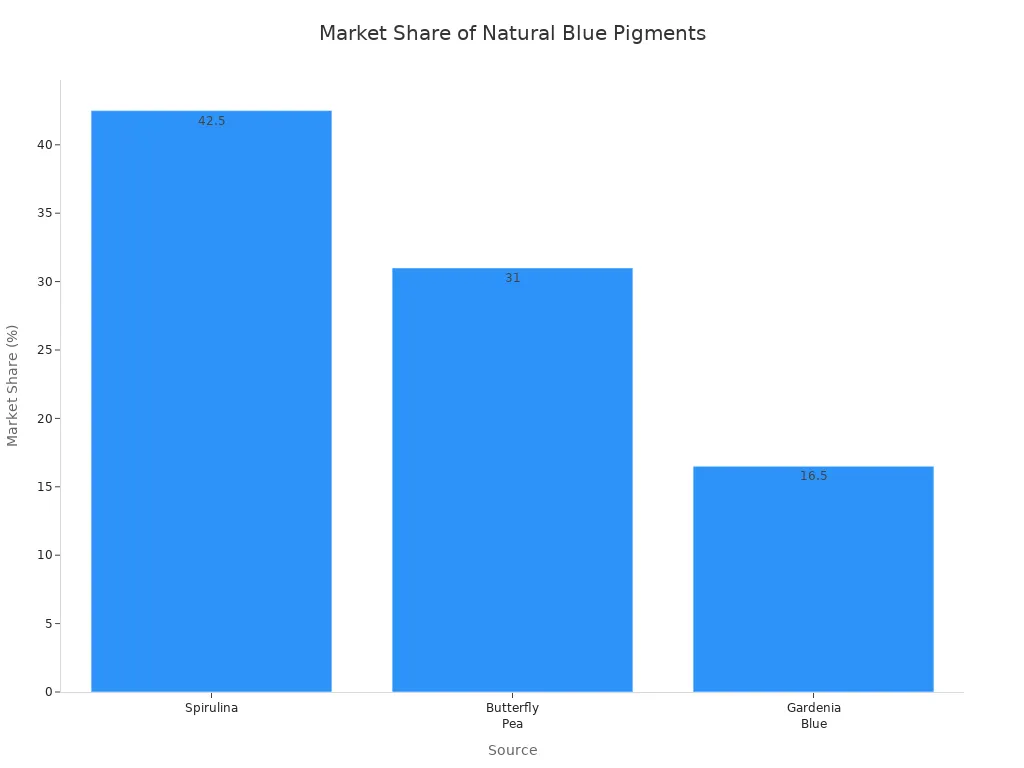
Today, you have more natural blue pigment choices than before. Spirulina and butterfly pea are the top options. Spirulina gives a bright blue from phycocyanin. This blue stays stable in many foods and drinks. Butterfly pea has blue from anthocyanins. This blue can change if the pH changes. Gardenia blue is another choice. It works well in baked goods because it does not fade with heat or light.
Source | Market Share (%) | Key Characteristics |
|---|---|---|
Spirulina | 42.5 | Rich in phycocyanin, vibrant and stable blue pigment |
Butterfly Pea | 31 | Contains anthocyanin, sensitive to pH changes |
Gardenia Blue | 16.5 | Stable under heat and light, suitable for baked goods |
Extraction and Formulation Advances
There are new ways to get blue pigments from nature. Scientists use special solvents, enzymes, and microwaves to get more color. These methods help keep the blue bright and stable. Microbial fermentation with spirulina makes a lot of phycocyanin. This pigment does not change color with pH. You see a true blue in foods like candy, yogurt, and drinks.
There are also new ways to make blue pigments last longer. Companies use co-encapsulation and pH-buffering to protect blue from light and heat. These new ideas help foods and products look good and stay fresh.
Better extraction makes pigments brighter.
New formulas make blue easier to use.
Stabilization technology keeps blue colors strong.
Industry Collaboration
Many companies and schools work together to solve blue pigment problems. Big brands like PepsiCo use natural blue in drinks. Patagonia Provisions and The Body Shop use spirulina blue to show they care about the planet. Universities in China do research to find better ways to use blue pigments.
Collaboration Example | Description |
|---|---|
Solazyma and PepsiCo | Partnership focusing on the strategic importance of natural blue colorants in beverages. |
Patagonia Provisions and The Body Shop | Brands leveraging spirulina blue pigment to enhance sustainability narratives and premium positioning. |
Academic institutions (Jiangnan University, China Agricultural University) | Contributing fundamental research to foster innovation and market expansion through cross-sector collaboration. |
Research teams want to make phycocyanin more stable and useful. You get better and safer food because of their work.
You help the Natural Color Shift by picking products with natural blue. As more people work together, you will see better blue colors in your favorite foods and products.
Consumer Impact
Product Appearance Changes
You see foods and products look different now. Companies use natural blue pigments more often. Many brands get blue from red cabbage. This pigment gives a strong color in candy and snacks. You notice these changes most in bright foods. The table shows how red cabbage blue affects looks:
Aspect | Description |
|---|---|
Source | |
Stability | Gives a stable and strong color instead of artificial colors |
Visual Appeal | Makes food look better, especially candy where bright colors matter |
Research Background | Universities and Mars Wrigley work together on natural color options |
Natural blue and synthetic blue are not the same. Natural blue looks softer or more earthy. Synthetic blue is brighter and lasts longer. Here is a comparison:
Aspect | Natural Blue Pigments | Synthetic Blue Pigments |
|---|---|---|
Color Vibrancy | Brighter and more steady | |
Stability | Can fade or change | Stays strong in many conditions |
Consumer Perception | May seem less nice | Often looks more appealing |
Labeling and Perception
You see more labels like “naturally colored” or “no artificial colors.” These labels help you pick what to buy. Natural colors often look good, but rules for labels can change. Synthetic colors must follow strict rules. The table shows the differences:
Type of Colorant | Labeling Requirements |
|---|---|
Natural Food Colors | Often seen as good; label rules change; not always accepted as safe. |
Synthetic Food Colors | Must follow strict rules and approval; usually safe if used right. |
Blue in food can make you feel calm and trust it. Health brands use blue because it feels reliable and special.
Blue links to trust and calmness, which can change your choices.
Health and special brands use blue for its reliable look.
Acceptance and Expectations
You expect foods to look a certain way. When you see “natural blue,” you may think it is healthier. Brands use natural colors to show who they are. Stores and rules push companies to use natural pigments. Surveys show you like products with “no artificial colors” on the label. This means you see more natural blue in new foods. The Natural Color Shift makes natural blue normal in what you buy.
Blue is hard to work with during the Natural Color Shift. Blue pigments are not common. They are not stable and have strict rules. New ways to get and keep blue are coming soon. AI helps make supply chains better for blue pigments. You help this change by picking clean-label products. You also ask for clear information from brands. Big changes happened before, like Walmart removing synthetic ingredients. Your choices help decide what companies do. Try new colors and support brands that care about health and the planet.
FAQ
What makes blue pigments so rare in nature?
You find blue pigments in only a few plants and animals. Most blue colors come from light tricks, not true pigments. Scientists struggle to get stable blue from natural sources.
Will natural blue colors change how my food tastes?
Some natural blue pigments can add earthy or bitter flavors. You may notice a slight change in taste. Companies work hard to keep flavors pleasant.
Are natural blue colorants safe for you?
You can trust natural blue colorants approved by the FDA. They must pass strict safety tests. Always check labels for clear information.
How can you keep blue colors bright in products?
You should store products away from heat and light. New technology helps protect blue pigments. Look for packaging that keeps colors fresh.