When you look at sorbic acid vs potassium sorbate, you see that both help stop mold and yeast in food. Potassium sorbate mixes better in water and is used more often in the food industry.
Sorbic acid helps keep bakery and dairy foods fresh.
Potassium sorbate helps poultry last longer and cuts down on food waste.
Both are very safe and do not change how food tastes or looks.
Key Takeaways
Sorbic acid and potassium sorbate help stop mold and yeast in food. – Potassium sorbate mixes easily with water, so it works well in drinks and wet foods. – Sorbic acid works best in dry or fatty foods like bread and cheese because it fights germs better. – Both preservatives are safe to eat, and food safety groups have set safe limits. – Pick the right preservative for your food: use potassium sorbate for drinks and sorbic acid for dry foods.
Sorbic Acid vs Potassium Sorbate Overview
Quick Comparison
The table below shows how sorbic acid and potassium sorbate are different. It lists their chemical names and formulas. You can also see how well each one mixes with water.
Compound | Chemical Name | Molecular Formula | Solubility in Water (at 25°C) | Main Use in Food |
|---|---|---|---|---|
Sorbic Acid (E 200) | (2E,4E)-hexa-2,4-dienoic acid | C6H8O2 | 0.16% | Bakery, dairy |
Potassium Sorbate (E 202) | Potassium (2E,4E)-hexa-2,4-dienoate | C6H7O2K | >50% | Beverages, meats |
Tip: Potassium sorbate mixes with water much better than sorbic acid. This makes it easier to use in many foods.
Key Similarities
Both sorbic acid and potassium sorbate help keep food fresh. They stop bad microbes from growing. They break the cell walls of microbes. They block nutrients from getting inside the cells. They stop enzymes that help microbes grow. They make the inside of the cell more acidic. This hurts the microbes. You can use either one to protect food from mold, yeast, and some bacteria.
Main Differences
Here are ways these two preservatives are not the same:
Sorbic acid comes from nature, like rowan tree berries. Potassium sorbate is made in labs from sorbic acid.
Sorbic acid works best in foods with low pH, like cheese or yogurt. Potassium sorbate works in more foods because it mixes better with water.
You find sorbic acid in bakery and dairy foods. Potassium sorbate is used in drinks, meats, and foods that need lots of water mixing.
Both are safe to eat. Groups like the FDA and EFSA say they are okay.
Sorbic Acid in Food Preservation
What Is Sorbic Acid?
You may wonder what sorbic acid is. This compound is a naturally occurring organic acid. Scientists first found it in unripe berries from the rowan tree. You can see sorbic acid as a colorless, needle-shaped powder. It does not have a strong smell. It resists light and heat well. Here are some facts about its chemical structure:
Structure: H3C−CH=CH−CH=CH−[C(=O)OH]
Found in nature, especially in rowan tree berries
How It Works
Sorbic acid helps keep food fresh by stopping the growth of mold, yeast, and some bacteria. When you add sorbic acid to food, it disrupts the way microbes use energy. It makes the inside of their cells more acidic. This slows down how they use glucose and make ATP, which is their energy source. Sorbic acid works best in foods with low pH, like cheese or yogurt. It is more powerful than acetic acid for stopping spoilage. You get longer shelf life and less waste.
Common Uses
You will find sorbic acid in many types of food. It helps preserve bakery items, dairy products, fruit spreads, and even meats. Here is a table showing where sorbic acid is used and how much is added:
Food Product Type | Usage Rate (g/kg) |
|---|---|
Beverages (fruit juices, wines) | 0.02 – 0.10 |
Emulsions (dressings, mayonnaise) | 0.05 – 0.10 |
Fruit-based products (jams, jellies) | 0.02 – 0.25 |
Dairy products (yogurt, cheese) | 0.05 – 0.30 |
Bakery products (cakes, doughnuts) | 0.03 – 0.30 |
Vegetable-based products (pickles) | 0.02 – 0.25 |
Meat and fish products (sausages) | 0.05 – 0.30 |
Sorbic acid does not dissolve well in water. You may see it used more in foods that do not need a lot of mixing.
Safety Profile
You can feel confident about the safety of sorbic acid. Food agencies set strict limits for how much you can use. Most foods have low amounts, but some products like meat can have up to 2 grams per kilogram. Here is a chart showing the maximum allowed concentrations:

Studies show sorbic acid is safe for most people. Some research suggests it may affect liver metabolism if you eat too much. You should always follow the recommended limits to keep food safe.
Potassium Sorbate Applications
What Is Potassium Sorbate?
Potassium sorbate is found in lots of foods and drinks. It is not from nature. People make it in labs. They mix sorbic acid with potassium carbonate. They use acetone and heat to help the process. Here is how potassium sorbate is made:
Mix sorbic acid with acetone.
Add potassium carbonate and stir.
Heat the mix until it reacts.
Cool it down and filter out potassium sorbate.
The table below shows the chemical parts:
Component | Formula |
|---|---|
Potassium sorbate | C6H8O2.K |
Sorbic acid | C6H8O2 |
Potassium | K |
Potassium sorbate mixes very well with water. This makes it easy to use in foods and drinks that need mixing.
How It Works
Potassium sorbate helps keep food and drinks safe. It breaks the cell walls of microbes. It stops enzymes that help microbes grow. This slows or stops mold, yeast, and some bacteria. Your food and drinks last longer.
Uses in Foods
Potassium sorbate is used in many foods and drinks. It mixes well with water. It does not change taste or look. Here is a table showing where you might see potassium sorbate:
Food Category | Examples of Products |
|---|---|
Beverages | Fruit juices, carbonated drinks, sports drinks |
Baked Goods | Bread, cakes, cookies, mooncakes |
Fruit and Vegetable Processing | Jams, dried fruits, pickled vegetables, canned foods |
Meat Products | Sausages, cured meat, ham, bacon |
Dairy Products | Yogurt, cheese, milk drinks |
You can find potassium sorbate in sodas and juices. It helps jams, baked goods, and dairy stay fresh. Many meats use potassium sorbate to stop spoilage.
Safety Profile
Potassium sorbate is safe when used right. Experts say it is okay at certain levels. You can have 25 milligrams per kilogram of body weight each day. This means you can eat foods and drinks with potassium sorbate safely. The World Health Organization and Food and Agriculture Organization agree it is safe. Companies must follow rules for how much they use and label it clearly.
Tip: Always check the label to see if potassium sorbate is in your food or drinks.
Effectiveness and Safety Comparison
Antimicrobial Activity
Sorbic acid and potassium sorbate are strong preservatives. They fight mold, yeast, and bacteria in food. Sorbic acid works better in foods with low pH. Potassium sorbate is a little less strong. You can use more of it to get the same effect.
The table below shows how they control yeast. Scientists checked Rhodotorula yeast growth over time. PR1 and PR2 are tests with sorbic acid and potassium sorbate.
Treatment | Rhodotorula Count (log10 CFU/g) | Day of Measurement |
|---|---|---|
PR1 | 6.60 | 3rd |
PR2 | 5.89 | 3rd |
CR | 6.97 | 3rd |
PR1 | Not detected | 21st |
PR2 | Not detected | 18th |
Both preservatives stop yeast growth after about three weeks. Sorbic acid works a bit faster.
Scientists also check the smallest amount needed to stop bacteria. The chart below shows the minimum amounts for common germs.
Microorganism | MIC (ppm) |
|---|---|
Acetobacter aceti | 2,000 |
Campylobacter coli | 250 |
Escherichia coli | 2,000 |
Clostridium perfringens | 1,000 |
Bacillus cereus | 2,000 |
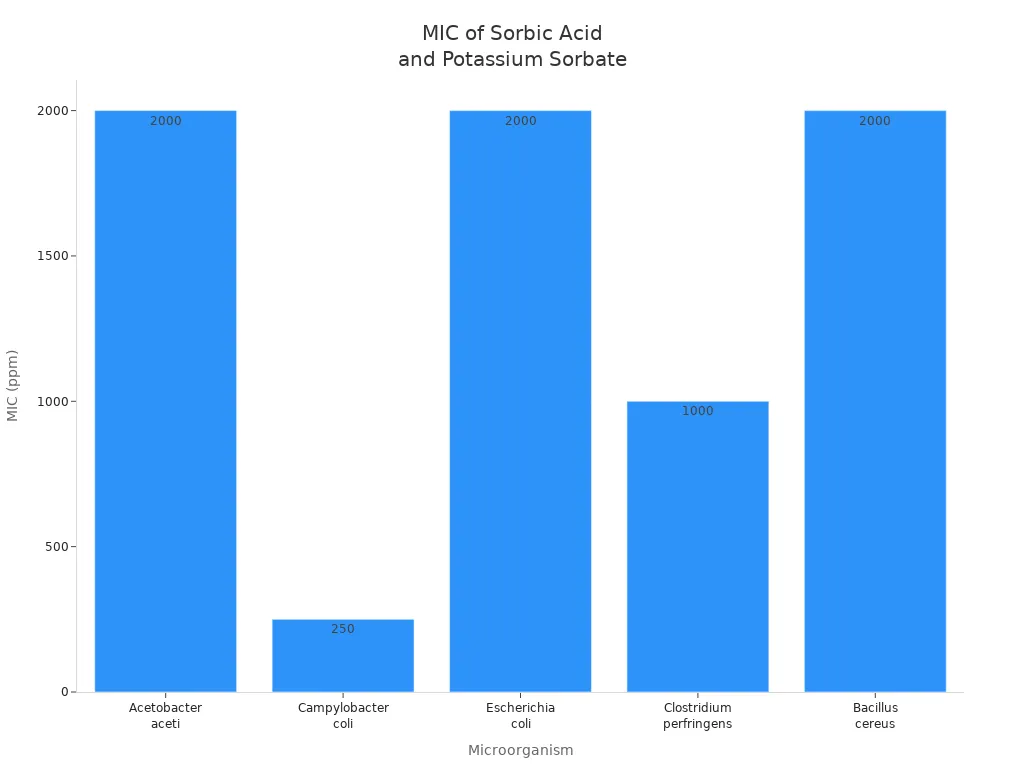
You can use either one to keep food safe from germs. Sorbic acid is a little stronger than potassium sorbate.
Solubility and Food Applications
It is important to know how well these mix with water. Sorbic acid does not dissolve well in water. This makes it hard to use in drinks or foods that need mixing. Potassium sorbate dissolves easily in water. You can use it in juices, sodas, and other liquid foods.
Potassium sorbate mixes better with water than sorbic acid.
Because it dissolves well, potassium sorbate works in more foods.
Sorbic acid is best for dry or fatty foods, like baked goods and cheese. Potassium sorbate is better for foods with lots of water, like jams, drinks, and meats. Manufacturers pick the one that fits their food best.
Consumer Safety
You may wonder if these preservatives are safe. Both have low toxicity. Scientists tested them in animals and people. They break down quickly in your body. Neither causes cancer. The table below shows their safety.
Compound | Toxicity Level | Carcinogenic Activity | Metabolism |
|---|---|---|---|
Sorbic Acid | Low | None | Rapidly metabolized |
Potassium Sorbate | Low | None | Similar metabolic pathways |
Groups like the FDA and EFSA set safe daily limits. You can eat up to 25 mg of potassium sorbate per kilogram of body weight each day. For sorbic acid, the limit is 11 mg per kilogram. These rules help keep food safe.
Additive | Acceptable Daily Intake (ADI) Levels |
|---|---|
Potassium sorbate | 0–25 mg/kg bw/day |
Sorbic acid | 0–11 mg/kg bw/day |
Most people do not have problems with these preservatives. Rarely, some people may get allergic reactions. Symptoms can be mouth tingling, swelling, or hives. If you have allergies, check food labels and avoid these additives.
Note: Allergies to sorbic acid and potassium sorbate are rare. Patch testing can help you find out which foods to avoid.
Manufacturer Considerations
If you make food, you need to pick the right preservative. Sorbic acid does not mix well with water, so it is used in dry or fatty foods. Potassium sorbate mixes well with water, so it is used in drinks and wet foods.
Manufacturers often use potassium sorbate for liquid foods. Sorbic acid works better, but you may need more potassium sorbate to get the same effect. You also need to think about how you add the preservative. Sorbic acid is good for dry mixes and fatty foods. Potassium sorbate is best for sprays, liquids, and foods that need even mixing.
Sorbic acid is stronger, but harder to use in liquids.
Potassium sorbate is easier to use, but you may need more.
Each preservative has its own strengths. You should choose based on your food type, how you make it, and what your customers want.
Choosing the Right Preservative
Factors to Consider
When you pick a preservative, you must think about many things. Every food is different. You want your food to stay safe and fresh. You also want it to look and taste good. The table below helps you compare sorbic acid and potassium sorbate:
Factor | Sorbic Acid | Potassium Sorbate |
|---|---|---|
Antimicrobial | Stops mold, yeast, and some bacteria | Stops mold, yeast, and some bacteria |
pH Effectiveness | Works best in foods with low pH | Works in foods with many pH levels |
Solubility | Does not mix well with water | Mixes well with water, good for liquids |
Concentration | Needs the right amount to work well | Used in small amounts |
Temperature | Works better when food is kept cold | Works well at many temperatures |
Safety | Approved by food safety groups | Approved by food safety groups |
You should also think about price, how well it mixes, and food rules. Potassium sorbate is often cheaper because lots of companies make it. Sorbic acid can cost more, but it fights germs better. Both are safe and allowed by food safety experts.
Factor | Sorbic Acid | Potassium Sorbate |
|---|---|---|
Solubility | Does not mix well in water | Mixes easily in water |
Regulatory Status | Safe according to experts | Safe according to experts |
Cost | May cost more | Costs less because it is common |
Effectiveness | Fights germs better | Needs more to work as well |
Tip: If you make drinks or foods with lots of water, use potassium sorbate. If you make dry or fatty foods, sorbic acid may be the better choice.
You now know that both sorbic acid and potassium sorbate help keep food safe. Each one preserves food by stopping mold and yeast. Potassium sorbate is more common because it dissolves in water easily. Sorbic acid works better in dry or fatty foods. You should pick the one that preserves food best for your product. Always check your food type and how you want to use the preservative.
FAQ
What foods most often contain potassium sorbate?
Potassium sorbate is in many foods. You can find it in sodas and fruit juices. It is also in jams, dried fruits, cheese, and cured meats. Packaged foods use it a lot. This is because it mixes with water well. It helps keep food fresh for longer.
Can you taste sorbic acid or potassium sorbate in food?
You will not taste or smell these preservatives. They do not change the flavor of food. They also do not change the color or texture. Food makers like them for this reason. They keep food safe without changing how it tastes.
Are sorbic acid and potassium sorbate safe for children?
Both are safe for kids if used in the right amount. Groups like the FDA and EFSA have checked them. Always read the label if your child has allergies. This helps you know what is in the food.
How do you know if a food contains these preservatives?
Look at the ingredient list on the package. You might see “sorbic acid” or “potassium sorbate” listed. Sometimes you will see their codes: E200 or E202.
Tip: If you do not want preservatives, pick foods that say “preservative-free.”