
You may see magnesium stearate in lots of supplements, medicines, and some foods. People talk about magnesium stearate benefits, but what does it really do for you?
It helps tablets and capsules stay smooth and even. This makes them easier to swallow.
It helps nutrients mix and absorb better in your body. This way, you get more from your vitamins.
Most experts say it is safe in the small amounts found in things you use every day.
Key Takeaways
Magnesium stearate makes supplements and medicines smooth. It helps them go down easily. Each dose is the same every time.
It works as a lubricant and stops clumping. Powders do not stick together in vitamins, food, or cosmetics.
Magnesium stearate helps nutrients mix well. This helps pills spread ingredients evenly.
Most experts say magnesium stearate is safe in small amounts. Health agencies agree it is safe in daily products.
If you have allergies or are sensitive, read product labels. Pick trusted brands to stay safe and get good quality.
What Is Magnesium Stearate?

Additive Role
You may wonder what magnesium stearate is. It is not a vitamin or a mineral supplement. It is a special salt made from magnesium and two fatty acids. These fatty acids are mostly stearic acid and sometimes palmitic acid. This salt looks like a white, fine powder. It does not dissolve in water or alcohol. But it can break down in hot water or hot alcohol. The powder feels greasy and melts at a high temperature. This helps it work well in many products.
Magnesium stearate works as a lubricant in supplements and medicine. When companies make tablets or capsules, they need to stop ingredients from sticking to machines. Magnesium stearate coats the particles with a thin, slippery layer. This layer helps everything move smoothly during production. Its special structure lets one part stick to powder and the other part push away water. This makes it great for this job.
You might not know that magnesium stearate can come from plants or animals. Manufacturers usually make it by mixing sodium stearate with magnesium salts. They can also treat magnesium oxide with stearic acid. The powder stops clumping and sticking. This makes it easier to make tablets and capsules.
Tip: If you are vegan or vegetarian, look for plant-based magnesium stearate.
Common Uses
You can find magnesium stearate in many products. Here are some common uses:
Supplements: It helps vitamins and minerals mix well. It also keeps tablets from breaking apart too soon.
Medications: It makes pills easier to swallow. It also helps control how fast your body absorbs the medicine.
Food products: It works as an anti-caking agent. This stops powders from clumping together.
Cosmetics: It gives powders a smooth feel. It also helps them spread evenly on your skin.
Magnesium stearate is used as a lubricant and anti-caking agent. This makes it popular in many industries. But making this compound can harm the environment. The process can create waste and pollution. This can affect people and nature. Because of this, more companies want to make magnesium stearate in a greener way.
So, next time you read a label on vitamins or snacks, you will know why magnesium stearate is there. It helps make your products better.
Magnesium Stearate Benefits
Manufacturing Efficiency
Many companies use magnesium stearate in their products. One big reason is that it helps make supplements and medicines. When you take a vitamin or pill, you want each dose to be the same. Magnesium stearate makes this happen. It works as a flowing agent. It keeps ingredients moving easily during production. This means you get the right amount of nutrients every time.
Magnesium stearate also stops powders from sticking to machines. If powders stick, tablets can break or look uneven. You get a better product because magnesium stearate fills tiny gaps on particles. This makes them rounder and less likely to clump. Here’s what it does:
Fills small holes on powder particles to make them smooth.
Lowers friction and stops powders from clumping.
Makes a slippery layer so tablets don’t stick to machines.
Manufacturers like magnesium stearate because it keeps production fast and steady. Rutgers University found that using only 1% magnesium stearate in tablets gives the most even results. Other excipients can’t match this level of consistency. You get a product that works the same way every time.
Note: Magnesium stearate saves money and works in many industries. It is stable and simple to use, so manufacturers choose it often.
Here’s a quick look at how magnesium stearate compares to other excipients:
Manufacturing Benefit | Explanation |
|---|---|
Lubrication | Lowers friction and helps machines work well. |
Anti-adherent | Stops particles from sticking to surfaces. |
Flow Agent | Improves powder flow and keeps doses even. |
Anti-caking Agent | Stops lumps from forming in powders. |
Cost-effectiveness | Saves money compared to other choices. |
Availability and Versatility | Works in supplements, food, and cosmetics. |
Chemical Stability | Stays stable in different conditions. |
Enhanced Absorption
You want your body to absorb nutrients from supplements and medicines. Magnesium stearate helps nutrients mix well and get absorbed. When magnesium stearate coats the particles, it keeps them from sticking together. This means your body can break down the tablet or capsule more easily.
Magnesium stearate helps nutrients spread out evenly in each pill. You get the same amount of vitamins or medicine every time. If powders clump, some pills might have too much or too little of an ingredient. Magnesium stearate stops this from happening.
Tip: If you take supplements, magnesium stearate helps your body get the most out of each dose.
But using too much magnesium stearate can slow down how fast your body absorbs the medicine. Manufacturers use just the right amount to balance these effects. Most products have safe levels that help with absorption without causing problems.
Product Stability
You want your supplements and medicines to last until you finish the bottle. Magnesium stearate helps keep products stable and fresh. It acts as a lubricant and flow agent. This stops ingredients from separating inside tablets or capsules. This keeps the medicine or vitamin strong and effective.
Magnesium stearate also helps blend ingredients evenly. You get a consistent product with every dose. It can even help with how fast your body absorbs the medicine in some cases. These features help keep your supplements safe and reliable.
In food and cosmetics, magnesium stearate works as an anti-caking agent. It keeps powders like baking mixes, spices, and drink powders from clumping. You get smooth, free-flowing products that are easy to use. In cosmetics, magnesium stearate helps powders and creams spread evenly and keeps them stable. It makes sure your makeup looks smooth and lasts longer.
Maintains product texture and stability.
Callout: Magnesium stearate is a low-hazard ingredient. It helps keep products safe, stable, and easy to use.
When you look at all these magnesium stearate benefits, you see why it’s so popular in supplements, medicines, food, and cosmetics. It helps make products better, safer, and more reliable for you.
Safety and Risks
Regulatory Status
You might wonder if magnesium stearate is safe. The FDA says it is “generally recognized as safe” (GRAS). This means it can be used in food, supplements, and medicine. Most tablets have less than 20 mg of magnesium stearate. Only a small part of that is real magnesium. The chance of getting too much is very low. You would need over 350 mg a day for it to be a problem. You cannot get that much from normal foods or supplements.
Many other groups agree with the FDA. Here is a table showing who approves magnesium stearate:
Regulatory Agency | Approval Status and Use |
|---|---|
FDA (USA) | GRAS, allowed in food and medicine |
EMA (EU) | Safe for pharmaceuticals |
JECFA (WHO/FAO) | Endorsed for supplements |
MHRA (UK) | Approved for medicines |
PMDA (Japan) | Approved for consumer products |
CDSCO (India) | Approved for drug safety |
These agencies make sure magnesium stearate is safe to use.
Side Effects
Most people do not have side effects from magnesium stearate. Studies show it does not cause common problems. Some people say it causes cancer or blocks vitamins, but research does not agree. Magnesium stearate does not coat your intestines or stop vitamin use. It goes through your body without causing harm.
Note: A few people may get a mild stomach ache or loose stools if they take too much. Allergic reactions are rare but possible. If you have allergies, watch how your body feels.
Who Should Avoid
Magnesium stearate can come from plants or animals. If you have allergies or are sensitive, check the label. People with bowel problems or stomach issues may want to avoid it. Rarely, someone may get hives or a rash. If you have histamine intolerance or mast cell problems, talk to your doctor before using it.
People with allergies or sensitivities
Those who get stomach upset
For most people, magnesium stearate is safe and does not cause trouble. If you worry, ask your doctor for advice.
Consumer Advice
Identifying in Products
You may want to know how to find magnesium stearate in things you use. It can have different names on labels. Sometimes, it is called:
Magnesium stearate
Octadecanoic acid
Magnesium distearate
Magnesiumoctadecanoate
Look for these names in the “inactive ingredients” part of medicine labels. On supplement bottles, check the “other ingredients” section. For over-the-counter medicine, read the package insert or back label. On supplements, look at the bottom of the label for extra ingredients. If the list is hard to understand, ask a pharmacist for help.
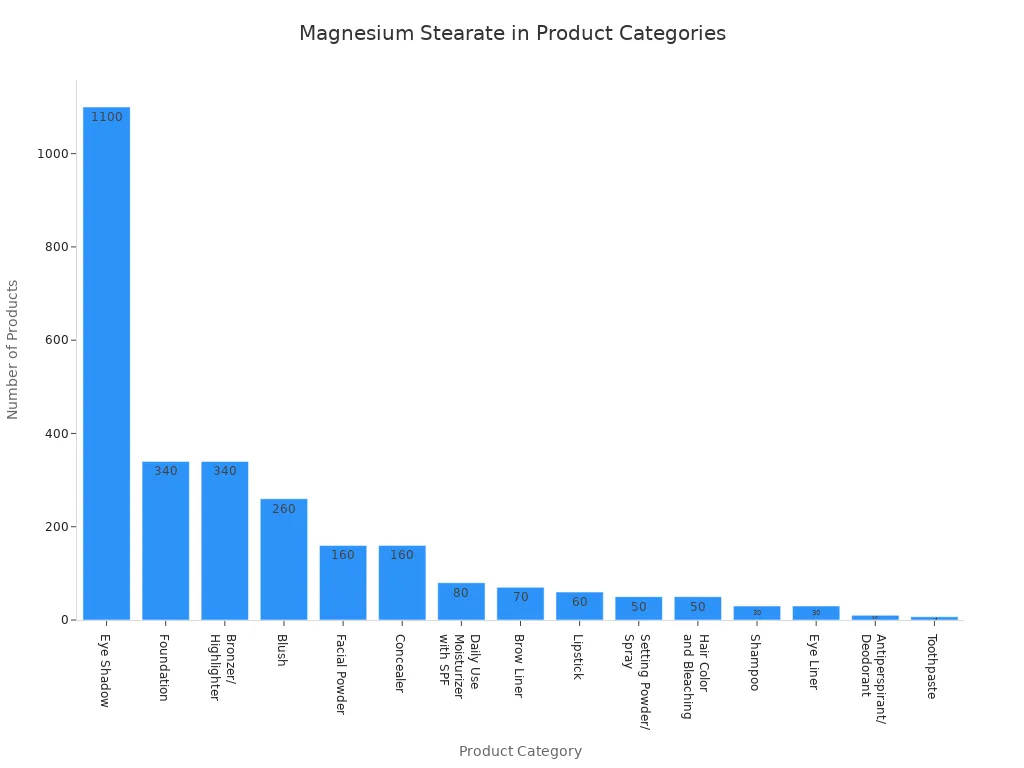
Magnesium stearate is not just in pills and vitamins. You will also find it in makeup and personal care items. Here are some places where it is used most:
Product Category | Approximate Number of Products Containing Magnesium Stearate |
|---|---|
Eye Shadow | Over 1100 |
Blush | Over 260 |
Foundation | Over 340 |
Bronzer/Highlighter | Over 340 |
Concealer | Over 160 |
Facial Powder | Over 160 |
Brow Liner | Over 70 |
Lipstick | Over 60 |
Shampoo | Over 30 |
Hair Color and Bleaching | Over 50 |
Daily Use Moisturizer with SPF | Over 80 |
Setting Powder/Spray | Over 50 |
Eye Liner | Over 30 |
Antiperspirant/Deodorant | Over 10 |
Toothpaste | Around 7 |
Making Informed Choices
You want to know what you put on your skin and in your body. Magnesium stearate is safe for most people when used as told. Groups like the FDA, EFSA, and WHO say it is safe in small amounts. Most products have less than 1%. Experts checked for side effects and found no big problems.
When you buy a supplement or makeup, pick brands that follow good rules. These companies use pure ingredients and test for quality. Many brands use plant-based magnesium stearate, which is good for vegans. If you have allergies or sensitive skin, read the label or ask your doctor.
Tip: Choose trusted brands with clear labels and safety checks. If you have questions, talk to a pharmacist or healthcare provider.
People in different countries think about magnesium stearate in different ways. In North America and Europe, most people trust products with strong safety rules. In other places, people may care more about eco-friendly or non-GMO choices. No matter where you live, you can make smart choices by reading labels and picking trusted brands.
Clear and honest information helps you feel sure. If you are not sure, ask an expert or look for advice from groups like the FDA or WHO. They work to keep your products safe and reliable.
You have learned the main magnesium stearate benefits. It helps make supplements and medicines safe and easy to use. It also keeps them stable so they last longer. Most experts say it is safe in small amounts. There is no strong proof it harms healthy people.
Always read labels if you have allergies or are sensitive.
Choose trusted brands for good quality and safety.
If you have health problems or special needs, talk to your doctor before trying new products. Knowing more helps you make the best choices for your health.
FAQ
Can magnesium stearate cause allergies?
Some people with allergies might get a rash or upset stomach. Most people do not have any problems. If you feel itchy or sick after using something, stop using it. You should talk to your doctor if this happens.
Is magnesium stearate safe for kids?
Magnesium stearate is in many vitamins and medicines for kids. Experts say it is safe when used in small amounts. Always ask your child’s doctor before giving new supplements.
Does magnesium stearate affect how my body absorbs vitamins?
Magnesium stearate helps mix ingredients and gives even doses. If there is too much, it can slow down how your body absorbs vitamins. Most products use safe amounts, so you still get the nutrients you need.
How do I know if a product contains magnesium stearate?
Check the ingredient list for “magnesium stearate” or similar names. You can also look for it under “inactive ingredients” on the label. If you are not sure, ask a pharmacist for help. Most brands show it clearly on their labels.