Have you ever thought about what makes isomaltulose and isomalt different when you see them on food labels? You might think they do the same thing, but they have very different jobs in food. People often talk about isomaltulose vs isomalt when they want healthier foods or better products. Picking the right one helps you meet your nutrition goals and makes food taste and feel better.
Key Takeaways
Isomaltulose gives slow and steady energy. It helps keep blood sugar steady. This makes it good for sports drinks and nutrition bars.
Isomalt is a sugar alcohol. It tastes like sugar but has fewer calories. It also helps protect your teeth. It is great for sugar-free candies and baked goods.
Both sweeteners are safe to eat. They help keep your teeth healthy. They do not make your blood sugar rise fast. This lets you enjoy sweet foods without worry.
Isomaltulose tastes less sweet than sugar. Isomalt tastes almost as sweet as sugar. Isomalt also helps keep food soft and fresh.
You can pick isomaltulose or isomalt based on your health goals. You can also use both together for better results.
Isomaltulose vs Isomalt Overview
What Is Isomaltulose?
Isomaltulose is found in foods that help you get steady energy. It is a kind of sugar called a disaccharide. Isomaltulose comes from sucrose, which is table sugar. Scientists use enzymes to change sucrose into isomaltulose. Isomaltulose has glucose and fructose joined by a special bond called α-1,6 glycosidic. This bond makes your body break down isomaltulose slowly. You get energy over time and your blood sugar does not rise quickly.
Isomaltulose is used in breakfast cereals, sports drinks, and baby food. You also see it in meal replacements and nutrition products. It helps you keep your blood sugar steady and gives you energy that lasts. Isomaltulose is safe for most people, even babies. You can find it in small amounts in honey and sugar cane juice.
Tip: If you want a sugar that does not make your blood sugar go up fast, isomaltulose is a good pick.
What Is Isomalt?
Isomalt is a sugar alcohol, also called a polyol. Isomalt is made by hydrogenating isomaltulose. This process changes isomaltulose and makes isomalt harder to digest. Isomalt is not a reducing sugar. You find isomalt in sugar-free candies, chewing gum, and baked goods. It helps lower the sugar in foods but keeps them sweet and tasty.
Isomalt does not make your blood sugar go up much. Your body takes in isomalt slowly, and it does not cause tooth decay. You use isomalt to replace sugar in foods for people who need less sugar.
Here is a table to help you compare Isomaltulose vs Isomalt:
Aspect | Isomaltulose | Isomalt |
|---|---|---|
Classification | Disaccharide | Disaccharide polyol (sugar alcohol) |
Origin | Derived from sucrose by enzymatic isomerization | Produced by hydrogenation of isomaltulose |
Chemical Structure | Glucose and fructose linked by α-1,6 glycosidic bond | Hydrogenated derivative of isomaltulose |
Digestibility | Digestible to glucose and fructose | Minimally digestible carbohydrate |
Usage | Functional alternative sugar | Sugar replacer in sugar-free products |
Reducing Sugar | Yes (due to ring-opening fructose) | No |
Isomalt comes from isomaltulose, but they do different things in food. Isomaltulose gives you slow energy and helps control blood sugar. Isomalt lets you eat sweet foods without extra sugar or tooth problems. When you read food labels, knowing about Isomaltulose vs Isomalt helps you pick what is best for you.
Structure and Production

Chemical Structure
You can spot big differences in the chemical structures of isomaltulose and isomalt.
Isomaltulose is a reducing disaccharide. It has glucose and fructose joined by an α-1,6 glycosidic bond (6-O-α-D-glucopyranosyl-D-fructofuranose).
This α-1,6 bond is not like the α-1,2 bond in sucrose. Because of this, isomaltulose is a reducing sugar, but sucrose is not.
The α-1,6 bond makes isomaltulose more stable in acid and slower to digest.
Isomaltulose tastes less sweet than sucrose, about half as sweet. It does not break down in acid and does not cause tooth decay.
The fructose part in isomaltulose can open up and show a carbonyl group. This makes isomaltulose a reducing sugar and lets it brown in foods.
These things give isomaltulose a lower glycemic index and help it stay stable in sour foods.
Isomalt has a different structure. It is a sugar alcohol made from two kinds of disaccharides: 1-O-α-D-glucopyranosido-D-mannitol (1,1-GPM) and 6-O-α-D-glucopyranosido-D-sorbitol (1,6-GPS). Each molecule has glucose joined to mannitol or sorbitol. When you break down isomalt, you get 50% glucose, 25% mannitol, and 25% sorbitol. This mix helps isomalt stay stable in wet air and not form crystals. Isomalt stays clear when it gets hot and does not turn brown easily. These features make isomalt great for sugar-free candies and baked treats.
Note: The special structures of isomaltulose and isomalt explain why they act so differently in foods. Knowing these differences helps you choose better when looking at Isomaltulose vs Isomalt.
How They Are Made
Here are the steps to make isomaltulose and isomalt:
Producers start with sucrose from sugar cane or sugar beets.
To make isomaltulose, they use special enzymes called sucrose isomerase (SIase). These enzymes break the α-1,2 bond in sucrose and change it to an α-1,6 bond, making isomaltulose.
Factories use two main ways for this step:
Microbial conversion: They use bacteria that make SIase to turn sucrose into isomaltulose.
Enzymatic conversion: They use pure SIase enzymes to do the same thing.
Some companies use genetic engineering to help bacteria make more SIase and work faster.
After making isomaltulose, they clean it so it is ready for food.
To make isomalt, they take the isomaltulose and hydrogenate it. This step adds hydrogen atoms and turns the sugar into a sugar alcohol.
The result is a mix of two sugar alcohols: 1,1-GPM and 1,6-GPS. This mix gives isomalt its special uses in foods.
You can see that making isomalt starts with making isomaltulose first. This step-by-step process makes sure both ingredients are safe and pure for your food.
Functional Properties
Sweetness and Taste
Isomaltulose tastes less sweet than regular sugar. It is about half as sweet as sucrose. The flavor is mild and not strong. If you want a gentle sweet taste, isomaltulose is a good pick. Isomalt tastes almost as sweet as sucrose. Foods with isomalt taste like foods with sugar. You will not notice much difference in sweetness with isomalt. Candies and baked goods made with isomalt taste sweet like sugar.
If you want food to taste as sweet as sugar, use isomalt. If you want a lighter sweet taste, choose isomaltulose.
Stability and Texture
Isomaltulose and isomalt both stay stable when heated or used in sour foods. Isomalt melts at a higher temperature, between 145°C and 150°C. It does not turn brown easily, so it works well for baking and candy. Isomalt does not soak up much water, so foods stay crisp and fresh. Isomaltulose melts at a lower temperature, around 123–124°C. It still works well in sour drinks and foods. It stays stable in strong acid for at least a day.
Isomalt gives baked goods a soft and moist feel, like sugar does. Muffins with isomalt are not hard or dry. Isomalt helps cakes and cookies keep the right texture. Polyols like isomalt can make starches thicken at higher temperatures. This changes how food feels when you eat it. There is not much known about how isomaltulose changes texture. It does not seem to change texture much in most foods.
Food Applications
Isomaltulose and isomalt are used in different foods because of their special features. Isomaltulose is found in sports drinks, cereals, and nutrition bars. It has a low glycemic index and is good for teeth. People who want steady energy or better dental health like isomaltulose. You might choose foods with isomaltulose if you care about blood sugar or want to avoid cavities.
Isomalt is used in sugar-free candies, chocolates, gum, and cake decorations. It does not melt or get sticky in heat or humidity. You can make clear and stable sugar shapes with isomalt. Isomalt is also used in sugar-free baked goods and gum. People who want less sugar but still want sweet treats often pick isomalt.
Here is a simple table showing where you find each one:
Ingredient | Common Uses |
|---|---|
Isomaltulose | Sports drinks, cereals, nutrition bars, meal replacements |
Isomalt | Sugar-free candies, chocolates, chewing gum, cake decorations, baked goods |
When you look at Isomaltulose vs Isomalt, you see each one has special uses. You can pick the one that fits your needs for sweetness, texture, or health.
Health and Nutrition
Blood Sugar Effects
You may wonder how these sweeteners change your blood sugar. Isomaltulose gives you slow, steady energy. It does not make your blood sugar jump fast. Studies show isomaltulose raises blood sugar less than regular sugar. Your body takes in isomaltulose slowly, so energy lasts longer. Insulin does not go up as much, so you avoid big spikes.
The insulin peak after eating isomaltulose is much lower than with sucrose.
Isomaltulose helps keep blood sugar steady when you exercise.
Isomalt has a low glycemic index too. But scientists have not tested it against isomaltulose in studies. You can see how they compare in this table:
Sweetener | Glycemic Index (GI) | Notes on Blood Glucose Impact |
|---|---|---|
Isomaltulose | 32 | Low GI; keeps blood sugar higher during exercise |
Maltodextrin | 90-100 | High GI; makes blood sugar rise quickly |
Dental Health
You want to keep your teeth healthy, so sweetener choice matters. Isomaltulose does not cause cavities. Studies show rinsing with isomaltulose keeps mouth pH safe for teeth. Sucrose drops pH and can hurt enamel, but isomaltulose does not. The FDA says isomaltulose does not cause tooth decay.
Isomalt also helps protect teeth. New studies show isomalt in mouth rinse can stop enamel loss. It may even help fix early tooth damage. Isomalt works with fluoride to make teeth stronger. It does not feed bad bacteria, so you can eat sweet foods without worry.
Tip: To keep your teeth safe, both isomaltulose and isomalt are good picks.
Calorie Content
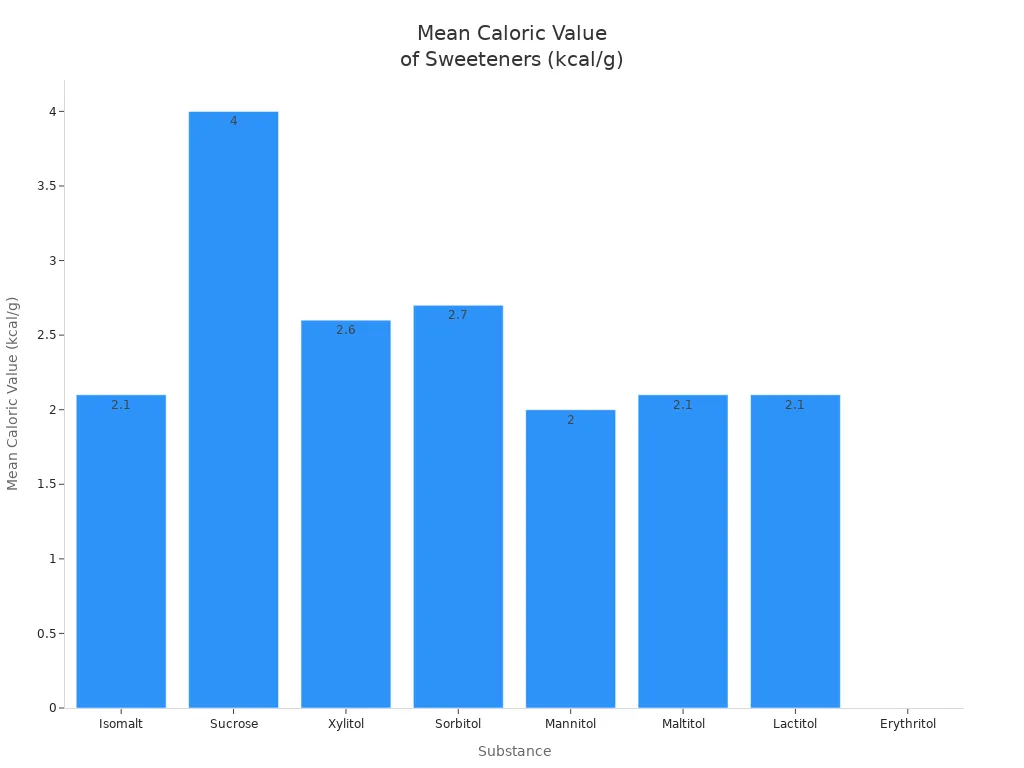
You might want to know how many calories these sweeteners add. Isomaltulose gives the same energy as regular sugar. Isomalt gives about half the calories. Isomaltulose is fully used by your body, so it gives you energy. Isomalt is only partly taken in and is fermented in your gut, so it has fewer calories.
Substance | Mean Caloric Value (kcal/g) |
|---|---|
Isomalt | 2.1 |
Sucrose | 4 |
Xylitol | 2.6 |
Sorbitol | 2.7 |
Mannitol | 2 |
Maltitol | 2.1 |
Lactitol | 2.1 |
Erythritol | 0 |
Isomaltulose and isomalt both help your health. They give steady energy, better blood sugar, and strong teeth.
Isomaltulose vs Isomalt in Food Choices
When to Use Each
You may wonder which sweetener to pick for your food. Each one works best in different foods. If you want steady energy and better blood sugar, pick isomaltulose. You can use it in sports drinks, cereals, and bars. Isomaltulose stays stable in sour foods and does not hurt teeth. It is safe for babies, adults, and people with diabetes.
Isomalt is great for sugar-free candies, chocolates, and baked treats. It keeps foods crisp and does not melt or get sticky. You can use isomalt for clear cake decorations or to keep gum sweet. Isomalt is a good choice if you want fewer calories in your snacks.
Tip: You can use both isomaltulose and isomalt in many foods. There are no strict rules stopping their use. Both are approved in the USA, EU, China, and more.
Consumer Considerations
When you choose between isomaltulose and isomalt, think about taste, health, and how your body feels. Isomaltulose tastes mild and sweet, about half as sweet as sugar. It gives gentle sweetness and does not upset your stomach, even in big amounts. Studies show isomaltulose is safe for babies, adults, and people with diabetes. It does not cause allergies or stomach pain.
Isomalt also tastes good and works well in coffee drinks and sugar-free candies. People like the texture and sweetness it gives to foods. Both sweeteners help protect teeth and do not cause cavities.
Here is a table to help you see how people feel about foods with isomaltulose and isomalt:
Aspect | Isomaltulose | Isomalt |
|---|---|---|
Sweetness | Mild, about 50% as sweet as sugar; pleasant taste | Similar to sugar; positive in coffee and candies |
Blood Sugar Impact | Low; helps manage blood sugar | Not specified |
Dental Health | Protects teeth; non-cariogenic | Not specified |
Tolerance | Well tolerated, even in large amounts | Not specified |
Product Applications | Good for chocolate, jellies, marshmallows, drinks | Good for instant coffee, candies, baked goods |
Consumer Perception | Mild, pleasant taste; higher scores than sugar-based controls | Positive in coffee drinks |
Both sweeteners have good points. When you look at Isomaltulose vs Isomalt, think about your health, taste, and the foods you want to eat.
You have learned that isomaltulose and isomalt are both helpful in foods.
Isomaltulose gives you energy that lasts and helps control blood sugar.
Isomalt can cut calories and keeps food sweet without hurting your teeth.
Nutrition experts say to pick one based on what you need, like fewer calories or a happy stomach.Knowing how they are different helps you and food makers choose the right sweetener for health and taste. Pick carefully to help you stay healthy.
FAQ
Can you use isomaltulose and isomalt in the same recipe?
Yes, you can use both together. Each one gives you different benefits. Isomaltulose helps you get steady energy. Isomalt keeps food sweet and lowers calories. You can mix them in baked goods or drinks. This can make your recipe work better.
Does isomaltulose taste like regular sugar?
Isomaltulose is not as sweet as regular sugar. It gives a mild and pleasant flavor. If you want a stronger sweet taste, you might need to add more isomaltulose. You can also mix it with other sweeteners.
Tip: Taste your food while you cook to find the best sweetness.
Is isomalt safe for people with diabetes?
Isomalt is safe for people with diabetes. It does not make blood sugar go up quickly. Your body digests it slowly. Many sugar-free foods for diabetes use isomalt.
Can isomaltulose or isomalt cause stomach upset?
Eating too much isomalt may cause stomach discomfort. Isomaltulose is usually easy for most people to digest. Try small amounts first to see how your body feels.
Sweetener | Stomach Tolerance |
|---|---|
Isomaltulose | High |
Isomalt | Moderate (in excess) |
Are isomaltulose and isomalt natural or artificial?
Both come from natural sugar called sucrose. Factories use enzymes and hydrogen to change sucrose into isomaltulose and isomalt. These ingredients start out natural but are processed for special uses.