
Natural food colors are derived from sources such as plants, minerals, or insects, while artificial food colors are created using chemicals. Understanding this distinction enables you to make healthier choices. A significant number of individuals prefer food that does not contain artificial colors. Research indicates that these artificial colors can lead to hyperactivity, mood fluctuations, and allergic reactions.
Approximately 75% of shoppers seek products free from artificial colors, flavors, or preservatives.
The demand for natural food colors is rapidly increasing, reflecting a growing concern among consumers about the ingredients in their food.
Key Takeaways
Natural food colors come from plants, minerals, or insects. Artificial colors are made from chemicals. Pick natural colors for a healthier choice.
Many people like foods without artificial colors. About 75% of shoppers want natural ingredients. This shows more people want natural foods.
Natural food colors are not as bright as artificial ones. They may not last as long. Heat and light can make them fade, so remember this when cooking.
Reading food labels helps you know what colors are used. Look for names like ‘beet juice’ for natural colors. ‘Red 40’ means the color is artificial.
To eat less artificial dye, pick brands with natural colors. You can also make your own colors with fruits and vegetables.
What Are Food Colors

Food colors help you see and enjoy your food. Groups like the FDA and EFSA say food colors are additives. They do three main things:
They fix color lost from light, air, or heat.
They make food look brighter.
They add color to plain foods.
You find food colors in candy, drinks, baked goods, and dairy. Every food color must pass safety tests. Their names or E numbers show they are safe.
Natural Food Colors
Natural food colors come from things in nature. You see these colors in fruits, vegetables, plants, minerals, or insects. These colors make food look bright without chemicals. Many people pick natural food coloring to avoid artificial stuff.
Some common natural food colors are:
Curcumin (E100): From turmeric roots. Used in mustard, yogurt, baked goods, dairy, ice cream, and salad dressings.
Carminic acid (E120): Made from the insect Dactylopius coccus. Used in jams, jellies, baked goods, dairy, and drinks.
Chlorophylls (E140): From plants like alfalfa. Added to dairy, soups, drinks, and candy.
Annatto (E160b): From Bixa orellana seeds. Used in cakes, cookies, rice, dairy, flour, fish, soft drinks, snacks, and meats.
Paprika extract (E160c): Has carotenoids and colors many foods.
Betanin (E162): From beets. Used in candy, ice cream, meat substitutes, and drinks.
Tip: To skip synthetic dyes, check for these natural food colors on labels.
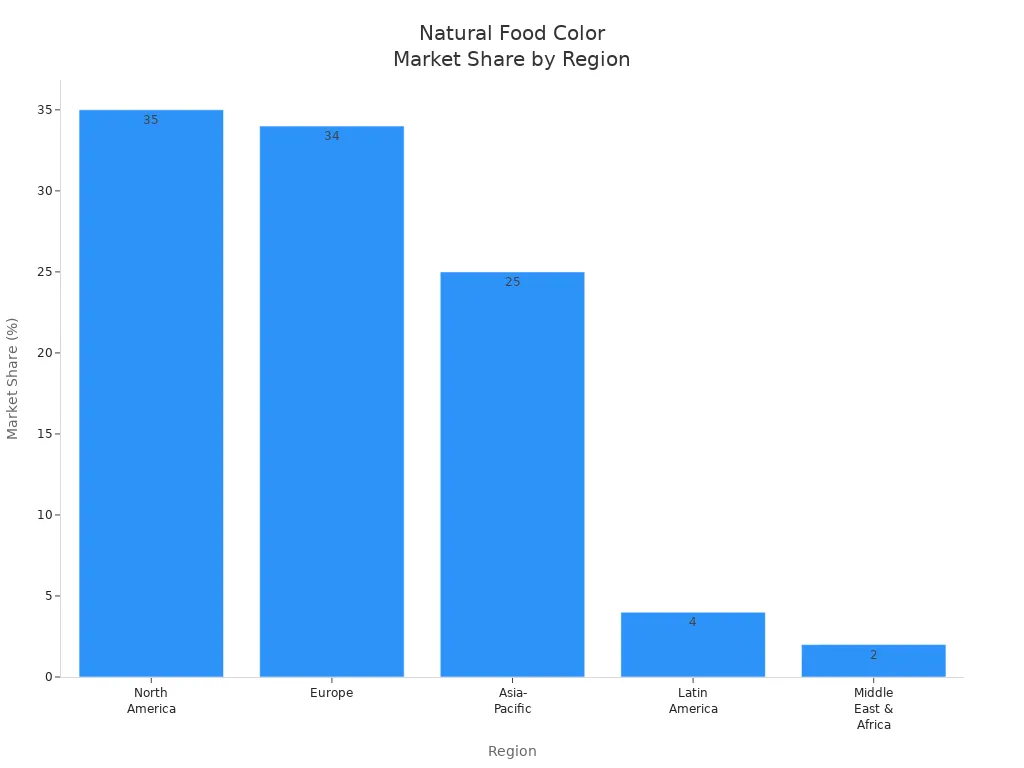
Natural food colors are getting more popular. The market is growing fast as people want natural ingredients. You may see more products with natural food coloring as companies follow this trend.
Artificial Food Coloring
Artificial food coloring uses dyes made from chemicals. These dyes do not come from nature. They are often cheaper and easier to make than natural ones. You find artificial food coloring in many processed foods. It gives bright colors that last longer.
The most used artificial food colorings are:
Red 40 (Allura Red)
Yellow 5 (Tartrazine)
Yellow 6
Blue 1
Blue 2
Green 3
Red 3
These dyes come from petroleum-based chemicals. They make food look better, but they are not natural. Synthetic food colors are still used a lot because they cost less and are simple to use. But natural food colors are becoming more popular as people want healthier choices.
Type of Food Color | Main Sources | Common Uses |
|---|---|---|
Natural | Plants, minerals, insects | Dairy, snacks, drinks, candy |
Artificial | Petroleum-based chemicals | Processed foods, drinks |
Both natural and artificial food colorings are important in food. Knowing the difference helps you choose what is best for you.
Sources of Natural Food Coloring

Plant and Mineral Origins
Many natural food colors come from plants and minerals. These sources give many color choices for food. Some plant-based dyes are annatto from achiote seeds, red cabbage for blue or purple, spinach for green, and paprika for red. You also find pigments like chlorophyll, carotenoids, anthocyanins, and flavonoids in fruits and vegetables. Beet juice makes food red or pink. Turmeric roots give yellow, and saffron adds a yellow shade. Caramel comes from heated sugar and gives brown color.
To make natural food colors, you follow a few steps:
Take out pigments from plants.
Filter to clean them.
Make the pigments stronger.
Freeze-dry to keep the color bright.
These steps help get pure color. But natural food dyes are more complex than artificial ones. Natural colors can change with heat or acid, so they are less stable.
Tip: You can make natural food colors at home. Try beet juice, spinach, or turmeric in your food.
Animal and Other Natural Sources
Some food colors come from animals or other natural things. Cochineal insects give carmine, a bright red dye. Hemoglobin from animal muscles and astaxanthin from shrimp shells add color too. Microbes like Aspergillus erythrorhizus make erythrulose, another coloring.
You use different ways to get these dyes:
Solvent extraction
Enzyme extraction
Microwave-assisted extraction
Ultrasonic extraction
Molecular distillation
Animal and microbe dyes are not as common as plant ones. But they are still used in food coloring. These dyes often need more energy and water to make. You may need more dye to get the same color as synthetic dyes.
Feature | Natural Food Colors | Artificial Food Colors |
|---|---|---|
Source | Fruits, vegetables, minerals | Petroleum, coal |
Purity | Perceived as purer | Synthetic, FDA certified |
Complexity | More complex, sensitive | Stable, easy to use |
Cost | Cheaper |
Natural food colors can change the taste a little. They may add earthy flavors. Artificial colors usually do not change taste. If you pick natural food dyes, you use fewer chemicals. But you may pay more and get colors that are less stable.
Stability and Performance
Light and Heat Sensitivity
Natural food colors can fade or change in sunlight or heat. This is because their pigments break down faster than artificial ones. If you leave a colored drink in the sun, the color may fade. Cooking or baking with natural coloring can also make it less bright.
Here is a table that shows how different things affect natural food dye stability:
Factor | Impact on Stability | Source |
|---|---|---|
Light Exposure | Prolonged exposure leads to pigment degradation, resulting in color fading. | Mulyaningsih et al., 2023 |
Oxygen Presence | Oxidation from atmospheric oxygen causes changes in color and flavor. | Enaru et al., 2021 |
Elevated Temperatures | Heat accelerates pigment breakdown, leading to color loss and structural changes. | Sun et al., 2023 |
pH Level | Stability varies with pH; some pigments are stable in acidic, others in alkaline. | Liu et al., 2022 |
Interactions | Interactions with food components can lead to degradation and color changes. | Mulyaningsih et al., 2023 |
Shelf-life Implications | Low stability affects shelf-life and consumer acceptance due to fading colors. | Ebrahimi et al., 2023 |
Manufacturers test food colors by putting them in heat, light, and different pH levels. They check how long the color stays in real foods.
Purity and Color Vibrancy
Natural food dyes do not look as bright as artificial ones. Foods with natural dyes often look softer or duller. Artificial food colors stay bold and bright for a longer time. This is why they are used in candy and drinks.
They break down when exposed to light and heat.
Artificial colors last longer and stay brighter.
Natural colorants are less stable than synthetic ones.
Natural colors usually have a shorter shelf life than synthetic colors.
Note: New technology like microencapsulation and fermentation helps natural colors last longer and look brighter. Companies use yeast and special packaging to help natural food dyes keep their color.
If you want to skip artificial dyes, remember natural ones may not look as bright or last as long. Still, many people pick them for fewer chemicals and a cleaner label.
Safety and Health
Are Natural Food Colors Safer
You may ask if natural food colors are safer. Many people pick natural food coloring for health reasons. Most natural food colors come from plants, minerals, or insects. These sources have been used in food for a long time. They are less likely to cause allergies or reactions.
Groups check food color safety before they are sold. Here is what some big groups do:
Regulatory Body | Approach to Safety Evaluation |
|---|---|
JECFA | Sets rules for checking natural food colors and focuses on safety. |
FDA | Checks food color additives, tests them, and needs proof they are safe. |
EFSA | Uses tougher tests for synthetic colors and puts warning labels on some. |
You can trust that natural food dyes get checked for safety. The FDA and EFSA both need proof that color additives are safe. The EFSA has stricter rules for synthetic dyes and sometimes adds warnings.
Note: Even natural food colors can cause allergies, but this is rare. Always read labels if you have food allergies.
Health Concerns with Artificial Food Coloring
Artificial food coloring can cause health problems for some people. Studies show some food dyes may cause allergy symptoms, hives, or asthma. Kids may react more to artificial food coloring. Some research links synthetic dyes to hyperactivity and behavior changes in kids.
Here are some common reactions to artificial food dyes:
Adverse Reaction | Associated Food Dyes |
|---|---|
Allergic reactions | Yellow 5 (tartrazine) |
Hives | Yellow 5 (tartrazine) |
Asthma symptoms | Yellow 5 (tartrazine) |
Hyperactivity | Red 40, Yellow 5, Yellow 6 |
Increased hyperactivity | Various food dyes |
About 52% of people with long-term hives or swelling had a reaction to artificial food dyes. Scientists found a link between synthetic dyes and hyperactivity in kids, especially those with ADHD. Some studies say current safety rules for artificial food coloring may not protect all kids from behavior problems.
Tip: To lower health risks, pick foods with natural food colors or natural food dyes instead of synthetic dyes.
Countries have different rules for food colorings. The EU and Canada have stricter limits and warning labels for some artificial dyes. The U.S. FDA allows more food dyes and does not always require warnings. You can protect your health by reading labels and picking foods with fewer artificial color additives.
Identifying Food Colors in Products
Reading Labels
You can find out what is in your food by reading the label. All packaged foods must show their ingredients. This includes food colors and food dyes. In the United States, you will see names like “FD&C Yellow No. 5” or “Vegetable Juice for Color.” In the European Union, labels use E-numbers, such as “E100” for curcumin. These codes help you know which coloring agents are in the food.
In the EU, food additives get a three- or four-digit code called an E number. In the US, additives are listed by their common names instead.
When you read a label, check for these things: the food’s name, the ingredient list with any additives, allergen information, the net quantity, best-use dates, and where the food comes from. Also look for the name and address of the food business, instructions for use, storage conditions, and nutrition facts.
The EU makes sure this information is easy to read by setting a minimum font size. The US has different rules, so labels may look different and show food colors in other ways.
Common Names and Codes
You will see many names and codes for food dyes on labels. Some labels just say “artificial colors” or “color added.” Others list the exact coloring agent, like “Annatto for coloring” or “Colored with beet powder.” Synthetic food dyes often use “FD&C” names, such as “FD&C Blue No. 1.”
Here is a table to help you spot common names and codes:
Type of Color Additive | |
|---|---|
Certified (Synthetic) | FD&C Yellow No. 5 |
Non-Certified (Natural) | Vegetable Juice for Color |
Common Name | Natural Color |
In the EU, you might see E-numbers like E100 for curcumin or E160b for annatto. The US does not use E-numbers, so you will see the full name instead. Some common artificial dyes are Green 1, Red 3, and Violet 1.
Many people do not know the difference between synthetic and natural color additives. The phrase “artificial colors added” can make you think all colors are synthetic. The FDA does not let companies use “natural” for color additives, which can be confusing.
If you want to skip synthetic food dyes, look for plant or mineral sources in the ingredient list. Knowing these names and codes helps you pick better foods.
You have learned that natural food colors come from nature. They are made from plants, minerals, or insects. Artificial food colors are made with chemicals. Natural food colors are better for your health and safety. You can make good choices by reading food labels. Pick foods with natural ingredients. Here are some ways to use less artificial dye:
Use fruit or vegetable juice and spices to color food at home.
Find snacks and personal care items that do not have dyes.
When you pick natural options, you help make food cleaner.
FAQ
What foods often contain artificial food coloring?
You can find artificial food coloring in many foods. These include:
Candy
Soda
Breakfast cereals
Ice cream
Packaged snacks
Tip: Always look at the ingredient list for color additives.
Can natural food colors cause allergies?
Most people do not have allergies to natural food colors. Some, like carmine from insects, can cause allergies but this is rare. If you have allergies, always check the label.
How can you tell if a food uses natural or artificial coloring?
Look at the ingredient list to find out. Natural colors have names like “beet juice” or “turmeric.” Artificial colors have names like “Red 40” or “Yellow 5.” In Europe, you can look for E-numbers.
Are natural food colors vegan?
Not all natural food colors are vegan. Some, like carmine, come from insects. Plant-based colors such as beet juice or spirulina are vegan-friendly.
Do natural food colors change the taste of food?
Natural food colors can give a light flavor. For example, beet juice can taste earthy. Most natural colors do not change the taste much.