What makes a plant leaf bright or helps muscles move? Cells need energy to work, and l-malic acid is very important for this. Scientists find l-malic acid in almost every living cell. It is in plant roots and animal tissues. This molecule helps make energy and keeps redox balance. It also helps immune cells in plants and animals. In plant cells, l-malic acid helps with energy and growth. Malic acid in plant tissues shows it is important for cell metabolism. L-malic acid also helps with signaling. This lets plant cells react to stress. Malic acid’s job in energy production links plants, animals, and microbes together.
Key Takeaways
L-malic acid is an important molecule. It is found in plants, animals, and microbes. It helps cells make energy using the TCA cycle.
It keeps redox balance by making molecules like NADH and NADPH. These molecules protect cells from harm. They also help build new things in the cell.
Plants use malic acid to grow and handle stress. It helps them talk to good microbes. This makes plants healthier and helps them survive.
Malic acid is in many fruits and vegetables. Apples have a lot of it. People use it in food and supplements for its sour taste and health effects.
Today, people use microbes to make pure l-malic acid. This way is better for the environment. It also helps with new science and technology in the future.
Malic Acid Overview
Structure and Properties
Malic acid is a tiny molecule, but it does a lot. Chemists call it 2-hydroxybutanedioic acid. Its formula is C4H6O5. In nature, l-malic acid is the main kind. This molecule has two carboxyl groups and one hydroxyl group. It sits on a backbone with four carbons. The shape helps l-malic acid mix with water. It also lets it react with other molecules. Inside cells, l-malic acid is part of the tricarboxylic acid (TCA) cycle. The TCA cycle is also called the Krebs cycle. This cycle helps change food into energy. The hydroxyl and carboxyl groups help l-malic acid move carbon. They also help move reducing power between cell parts. In mitochondria, l-malic acid helps make ATP. ATP is the energy for cells. In plants, l-malic acid helps move CO2. It also controls how stomata open and close. This connects l-malic acid to photosynthesis. Photosynthesis is how plants make food from sunlight.
L-malic acid and D-malic acid are two types of malic acid. Only l-malic acid works in living things. The table below shows how they are different:
Aspect | L-Malic Acid | D-Malic Acid |
|---|---|---|
Occurrence | Found in fruits, active in humans | Not found in nature, not active |
Role in Metabolism | Part of Krebs cycle, makes energy | No role in humans |
Source | Apples, grapes, other fruits | Synthetic, rare |
Bioavailability | Active and usable by the body | Not active |
Use in Industry | Used in food and supplements | Not used in biology |
Natural Occurrence
L-malic acid is found in many fruits and vegetables. Apples have the most l-malic acid. Wild apples can have 2.58 to 29.27 mg per gram. Apples that are grown have less, from 1.72 to 10.10 mg per gram. Other fruits like loquats, lychees, crisp pears, and lotus fruits have a lot too. Peppers and leafy greens like lettuce also have l-malic acid. In plants, l-malic acid helps with photosynthesis and growth. The chart below shows how much malic acid is in different foods:

L-malic acid is not just in fruits. It is also in plant roots and leaves. In plants, l-malic acid helps move carbon during photosynthesis. It also helps plants deal with stress and grow better. Because l-malic acid is so important, scientists study it in many plants.
Cellular Metabolism

TCA Cycle and Energy
Cells use the TCA cycle to make energy. This cycle happens inside mitochondria, which are like tiny power plants. Malic acid is important in the TCA cycle. It helps the cycle work by making sure intermediates are replaced. When there is more malic acid, oxaloacetate goes up too. Oxaloacetate joins with acetyl-CoA to start the cycle again. This helps break down acetyl-CoA and gives off energy.
Malic acid keeps the cycle moving so energy is made.
The TCA cycle makes NADH and FADH2. These carry electrons to the electron transport chain.
The electron transport chain uses these electrons to make ATP. ATP is the main energy source for cells.
When malic acid turns into oxaloacetate, it makes NADH. This helps make more ATP.
Plants use malic acid in mitochondria to grow and move. In plant cells, malic acid helps with photosynthesis. It moves carbon and helps make energy. Studies show yeast and microbes can make or use malic acid. This depends on their type. This helps them change their metabolism to make energy well.
Malic acid connects breaking down and building up processes in cells. It feeds into the TCA cycle and helps both sides work.
Redox Balance
Malic acid helps keep the cell’s redox balance. Redox balance means the cell controls oxidized and reduced molecules. This protects cells from damage by reactive oxygen species. In mitochondria, malic acid is used by malic enzymes. These enzymes help make NADPH. NADPH helps defend against damage.
Malic acid makes NADH and NADPH. These help control energy and redox states.
NADPH helps change oxidized glutathione back to its reduced form. Glutathione protects cells from stress.
Malic acid raises the GSH/GSSG ratio and lowers the NADP+/NADPH ratio. This shows better redox balance.
Malic acid moves reducing power between cell parts using the malate valve.
Plants use malic acid to handle redox signals when stressed. The malate valve moves redox power from chloroplasts to the cytosol. This keeps the cell’s redox state steady. Malic acid can switch between pathways. This helps plants adjust to changes and keep making energy.
Malic Enzyme and NADPH
Malic enzymes use malic acid to make NADPH. NADPH is needed for many cell jobs. Mammals have three malic enzymes: ME1, ME2, and ME3. ME1 works in the cytosol and makes NADPH for building things. ME2 and ME3 work in mitochondria and help with energy and breathing.
Malic enzyme changes l-malic acid into pyruvate and makes NADPH.
NADPH helps make fatty acids and other things that need reducing power.
Malic enzyme links glycolysis, gluconeogenesis, and the TCA cycle. It helps refill intermediates and lets cells change their metabolism.
In plants and microbes, malic enzyme activity matches with more lipids. If malic enzyme is blocked, less lipid is made. This shows it is important for storing energy.
Malic acid helps cells make NADPH. This lets cells build new things and fight stress. Plants use malic enzyme to make new molecules and adjust to changes. Malic acid carries carbon and reducing power. It is needed for energy and metabolism in all living things.
Malic Enzyme Isoform | Location | Main Function | Importance for Energy Production |
|---|---|---|---|
ME1 | Cytosol | NADPH for biosynthesis | Helps make fatty acids |
ME2 | Mitochondria | NADH/NADPH for respiration | Makes ATP |
ME3 | Mitochondria | NADPH for redox balance | Keeps redox balance |
Plants, animals, and microbes all need malic acid and l-malic acid. These molecules help cells make energy, keep redox balance, and build new things. Malic acid’s job in energy production links all living things together.
Biological Functions
Signaling and Messenger Roles
L-malic acid does more than help with metabolism. It acts as a signal in plants and microbes. In bacteria, l-malic acid changes how the RecN protein works. RecN helps fix DNA when it is damaged. When there is more l-malic acid, RecN gets busier and moves to where it is needed. This means l-malic acid helps cells deal with stress and damage. In plant roots, l-malic acid sends signals to helpful bacteria like Bacillus subtilis. These bacteria help plants grow and stay healthy. L-malic acid also causes changes in harmful bacteria genes. This can change how these bacteria move and live on plants. Because of this, l-malic acid links energy, health, and disease prevention in many living things.
Host-Microbiota Crosstalk
L-malic acid affects how hosts and their gut microbes work together. Animal studies show that eating l-malic acid changes gut bacteria types. For example:
L-malic acid raises some bacteria that help antioxidant enzymes work better.
It lowers bad short-chain fatty acids, which can help stop swelling.
Gut bacteria changes affect how the body uses amino acids and fats.
These changes help stop disease by making the immune system stronger and lowering swelling.
L-malic acid helps plants and their microbes work together for better health.
Antioxidant Defense
L-malic acid helps protect against damage from free radicals. In animals, it increases the number of muscle fibers that fight damage. Taking l-malic acid lowers signs of stress and swelling in tissues. It also makes muscles better, which means more protection from damage. In broilers, l-malic acid boosts enzymes that keep cells safe. This helps stop disease by keeping cells strong and healthy. Plants use l-malic acid to handle stress from tough conditions. These jobs show how l-malic acid connects energy, health, and plant survival.
L-Malic Acid in Plants and Microbes

Plant Stress Response
Plants need l-malic acid to live through hard times. When it gets cold, dry, or there are bad metals, l-malic acid goes up in plant cells. This helps plants change their inside balance. Malic enzymes, like NADP-malic enzyme, are very important here. When plants get stressed, NADP-malic enzyme works harder. Rye plants have more malate and enzyme action when it is cold. After the cold ends, these levels go down. This shows plants can react fast to stress.
In wheat, some NADP-malic enzyme genes turn on more during cold. These genes help plants keep water and solute levels right. This keeps cells safe from harm. Plants also use l-malic acid to fight reactive oxygen species. This keeps cell walls soft and helps photosynthesis work well. Arabidopsis plants without NADP-malic enzyme get sick easier. But plants with more NAD-malic enzyme can handle salt and stress better. This shows l-malic acid helps plants grow and deal with stress.
Plants use l-malic acid to change fast when things get tough. This helps them keep making food and live through dry or cold times.
Microbial Metabolism
Microbes use l-malic acid in many ways to get energy and grow. The table below shows how microbes use l-malic acid and which enzymes help:
Pathway | Description | Key Enzymes | Mechanism Summary |
|---|---|---|---|
Reductive TCA (rTCA) | Used by yeast and fungi; happens in the cytosol | Pyruvate carboxylase, Malic acid dehydrogenase | Changes pyruvate to oxaloacetate, then to l-malic acid |
Glyoxylate Pathway | Found in bacteria and some fungi | Isocitrate lyase, Malic acid synthetase | Makes l-malic acid from glyoxylate and acetyl-CoA |
One-step Pathway | Switches between pyruvate and l-malic acid | Malic enzyme | Uses NAD+/NADP+ to change between pyruvate and l-malic acid |
Microbes use these ways to help with photosynthesis-like jobs and to handle changes around them. The reductive TCA pathway lets microbes make lots of l-malic acid. This helps them live when food is low. The glyoxylate pathway lets bacteria and fungi use simple carbon for energy. The one-step pathway gives them more choices for making energy. These ways show l-malic acid is key for microbes to grow and live.
Malic Acid Production and Applications
Industrial Production
Making malic acid has changed a lot over time. Factories used to make it with chemicals from maleic or fumaric acid. This way makes both d- and l-forms, but only the l-form works in living things. Chemical methods use oil-based materials and make waste. Now, many companies want cleaner ways to make malic acid. Microbial fermentation uses fungi or bacteria to turn sugars into l-malic acid. Ustilago trichophora TZ1 can make almost 200 g/L without changing its genes. Aspergillus oryzae can make up to 178 g/L in repeated batches. These ways use renewable things like glycerol and plant leftovers. Industrial fermentation and fermentative production make less pollution and give pure l-malic acid. But there are still problems, like getting enough oxygen and cleaning the final product. The table below shows how different ways to make malic acid compare:
Production Method | Yield / Titer | Notes |
|---|---|---|
Chemical Synthesis | Industrial scale | Makes racemic mixture, uses oil-based feedstocks |
Enzymatic Hydration | Pure l-malic acid | Costly, not eco-friendly |
Microbial Fermentation (A. oryzae) | Up to 178 g/L | Needs pH control, uses renewable feedstocks |
Microbial Fermentation (U. trichophora) | Nearly 200 g/L | Highest yield, uses glycerol, promising for scale-up |
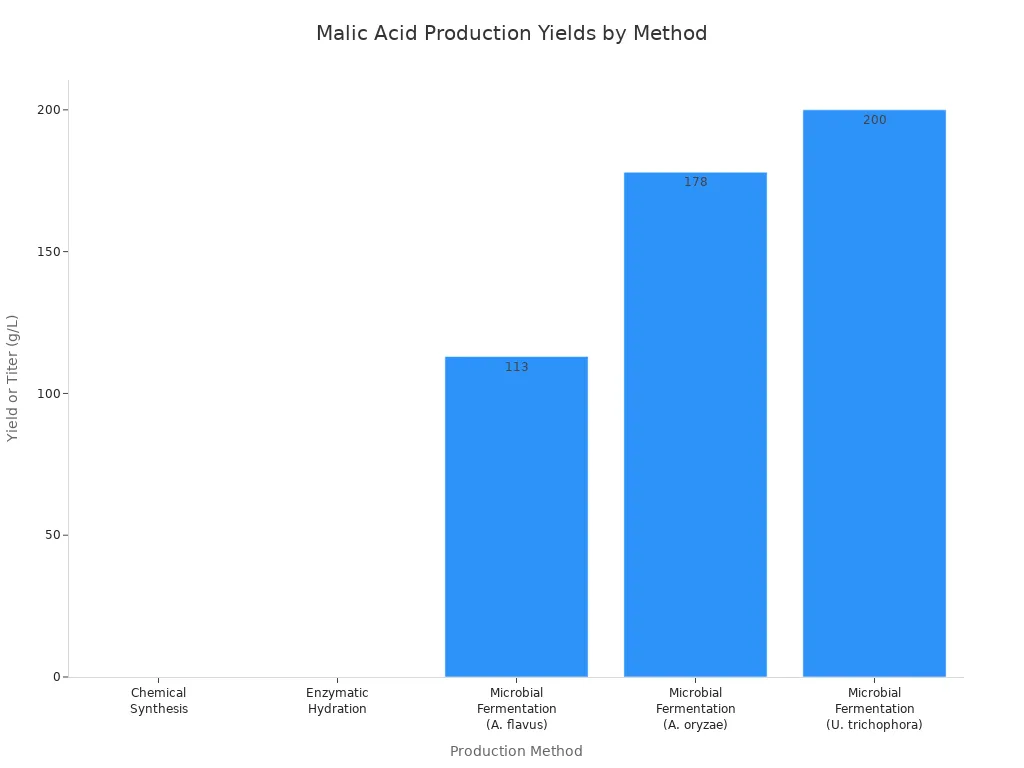
Making malic acid with fermentation helps the environment. Malic acid is safe for nature, but chemical ways can pollute.
Food and Beverage Uses
Malic acid is used in many foods and drinks. It gives fruit juices, candies, and baked goods a tart taste. This acid helps balance sweet and sour flavors. Malic acid lowers pH, which keeps food fresh and safe. It stops bacteria and mold from growing, so it works as a preservative. Many companies use malic acid in natural foods because it comes from plants. It also helps keep fruit products colorful and tasty. In wine, malic acid helps control acidity and makes the flavor better. The food industry likes malic acid because it is clean and good for the environment.
Medical and Nutritional Benefits
Doctors and scientists study malic acid for health reasons. Tests show malic acid can help dry mouth by making more saliva. Some studies look at malic acid with magnesium for fibromyalgia, but results are mixed. Higher amounts might help pain, but more research is needed. Malic acid can help stop kidney stones by blocking crystals. Most people can use malic acid safely, but some may get mild stomach upset. The body uses malic acid from plants to make energy, which may help with tiredness. The health and fitness industry uses malic acid to make supplements for muscle recovery. Fermentative production and microbial fermentation make pure l-malic acid for these products.
Metabolic Engineering
Pathway Optimization
Metabolic engineering lets scientists change how cells make malic acid. They use pathway optimization to get better results. This means they change biosynthetic pathways to make more product and less waste. Many strategies focus on the reductive TCA pathway. This pathway uses carbon very well. Scientists often remove genes that make by-products. For example, deleting the oahA gene in Aspergillus niger stops oxalic acid from forming. This change makes malic acid production go up by 40%.
Researchers also increase the amount of genes like pyc and mdh3. These genes help move more carbon through the biosynthetic pathways. Adding transporter genes, such as trmae1, helps cells send out malic acid faster. Sometimes, titers go over 200 g/L after fermentation. Scientists also use directed evolution to make key enzymes better. They adjust coenzyme regeneration to keep NADH and NADPH balanced. In E. coli, making PEP turn into oxaloacetate faster and raising NADPH helps make more malic acid. These strategies use optimization to get higher yields and make the process work better.
Pathway optimization uses gene editing, enzyme improvement, and transporter overexpression. These steps help cells use metabolic pathways to make more malic acid.
Biotechnological Advances
Biotechnological advances have made malic acid production better for the environment. Metabolic engineering now lets scientists design special microbial cell factories. These cells use improved biosynthetic pathways for better fermentation. Scientists have changed non-conventional yeasts like Yarrowia lipolytica. They change the malonyl-CoA pathway to make more malic acid and get better yields. Integrated biorefinery strategies use waste streams with a lot of xylose. Adaptive evolution and targeted genetic engineering help microbes use these streams to make malic acid.
These advances lower harm to the environment and make bio-based malic acid production possible. Better yields and efficient fermentation mean companies can use renewable resources. The engineering of biosynthetic pathways, along with pathway optimization, helps companies succeed. Metabolic engineering strategies keep making progress in this field. They help create new ways to use metabolic pathways for sustainable production.
Malic acid supports life in many ways. It helps cells make energy, keeps redox balance, and acts as a messenger. Plants use malic acid to grow, handle stress, and work with microbes. People benefit from malic acid in daily life:
It supports oral health and keeps teeth strong.
It aids digestion and supports gut bacteria.
Scientists keep improving how plants and microbes make malic acid. Future research may focus on better fermentation and choosing the best plant strains. These steps can help make malic acid more useful in biotechnology.
Malic acid connects plant health, human wellness, and new technology. Its many uses show why it matters for science and industry.
FAQ
What foods have the most malic acid?
Apples, grapes, and cherries have high levels of malic acid. Leafy greens and some vegetables also contain it. People often taste malic acid as a tart flavor in these foods.
How does malic acid help the body make energy?
Cells use malic acid in the TCA cycle. This cycle helps turn food into ATP, which gives energy to muscles and organs. Malic acid acts as a key step in this process.
Is malic acid safe to eat?
Most people can safely eat malic acid in foods. The body uses it naturally. Some people may feel mild stomach upset if they take large amounts in supplements.
Can malic acid help with muscle fatigue?
Some studies suggest malic acid may help reduce tiredness after exercise. It supports energy production in muscle cells. More research is needed to know how well it works for everyone.