You may hear that spirulina is good for nutrition, but its real power comes from phycocyanin, which is a strong blue pigment. This pigment is about 15-25% of spirulina’s dry weight. It also gives the algae its bright color. When you look for health benefits, you see that phycocyanin gives important antioxidant and anti-inflammatory effects. Knowing this link helps you pick better supplements for your nutrition.
Key Takeaways
Spirulina is a superfood. It has lots of protein, vitamins, and minerals. These help your body stay healthy.
Phycocyanin is the blue color in spirulina. It gives strong antioxidant and anti-inflammatory help.
Using spirulina and phycocyanin together helps your immune system. It also helps fight swelling and germs.
You can eat spirulina by putting it in smoothies or snacks. You can also take it as a supplement.
Pick good quality spirulina and phycocyanin products. This helps you get more health benefits and stay safe.
Spirulina overview
What is spirulina
Spirulina is a kind of microalgae. People call it blue-green algae because of how it looks and its color. It belongs to a group called Arthrospira. There are 23 types that scientists have approved in this group. Spirulina grows in lakes with a lot of alkaline and high pH. These places are found in South Africa, Mexico, and northern Australia. Farmers grow spirulina in open ponds that copy these natural places. This way, they can make a lot of spirulina for food and supplements.
Did you know? Spirulina can live in tough places where most other microalgae cannot. This makes it a good choice for making food in a way that does not harm the planet.
Classification Level | Name |
|---|---|
Genus | Arthrospira |
Species |
Spirulina’s nutritional profile
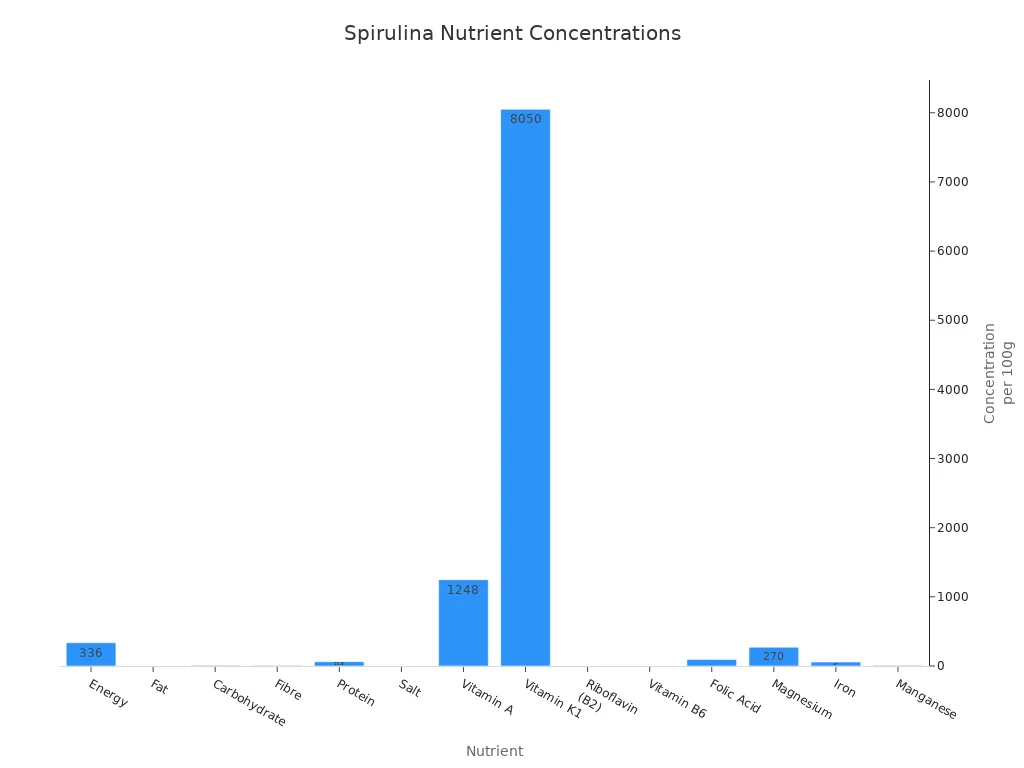
Spirulina is special because it has a lot of protein. Dried spirulina has about 57% protein. This is more than most other microalgae. The protein gives you all the amino acids your body needs. Spirulina also has carbohydrates, fats, vitamins, and minerals. These nutrients help make spirulina a superfood.
Nutrient | Per 100g |
|---|---|
Energy | |
Fat | 0.2 g |
Carbohydrate | 8.0 g |
Fibre | 8.4 g |
Protein | 62.8 g |
Salt | 0.128 g |
Vitamin A | 1248 µg |
Vitamin K1 | 8050 µg |
Riboflavin | 0.86 mg |
Vitamin B6 | 0.72 mg |
Folic Acid | 94 µg |
270 mg | |
Iron | 57 mg |
Manganese | 5.7 mg |
You get a lot of protein, healthy fats, and vitamins like B12, A, and E from spirulina. It also gives you minerals such as iron, calcium, magnesium, and potassium. Spirulina has pigments like chlorophylls and carotenoids too. Your body can use these nutrients easily because they are very bioavailable. Growing spirulina in farms helps keep the quality and amount the same. This is why people call spirulina a superfood and why microalgae are important for nutrition. Spirulina helps feed people around the world and gives a protein source that is good for the planet.
Microalgae like spirulina give you protein.
Growing spirulina helps make more supplements.
Microalgae have a lot of protein and important nutrients.
What is phycocyanin
Phycocyanin in spirulina
Phycocyanin is the main blue pigment in spirulina. It makes up about 15-25% of spirulina’s dry weight. You can see its bright blue color in spirulina powder or supplements. This pigment is part of a group called phycobiliproteins. These pigments help spirulina use light for photosynthesis. The table below shows how the pigment works:
Component | Description |
|---|---|
Type | Pigment-protein complex from the phycobiliprotein family |
Structure | Composed of alpha and beta subunits with linear tetrapyrrole chromophores |
Function | Accessory pigment in photosynthesis, absorbs orange and red light, transfers energy to chlorophyll |
Color | Characteristic light blue color |
Absorption Peak | Absorbs light at approximately 620 nm |
Emission Peak | Emits fluorescence at about 650 nm |
Aggregation | Forms clusters called phycobilisomes, which adhere to the membrane |
The pigment takes in orange-yellow light and gives energy to chlorophyll. This helps spirulina grow and make more cells. The pigment is also used as a natural food color in many products.
To get phycocyanin from spirulina, people use different methods. Some ways are pulsed electric fields, high-pressure processing, freeze-thawing, and bead milling. Glycerine maceration is another way that keeps the pigment safe for food. Each method changes the purity and quality of the pigment. If you want good pigment for supplements or foods, you need to focus on c-phycocyanin extraction.
C-phycocyanin and its properties
C-phycocyanin is the main type of phycocyanin in spirulina. It has strong effects that help your body. Scientists have studied phycocyanin and found many health benefits. The pigment works as an antioxidant, anti-inflammatory, and immune booster. The table below shows some bioactive properties:
Bioactive Property | Effect |
|---|---|
Antioxidant | C-phycocyanin enhances serum SOD and catalase activity, surpassing vitamin E. |
Anti-inflammatory | C-phycocyanin reduces COX-2 and PGE2 expression in activated macrophages. |
Immunomodulatory | C-phycocyanin suppresses pro-inflammatory cytokines like TNF-α and IFN-γ. |
Cytokine Regulation | Enhances anti-inflammatory cytokines such as IL-10 in a concentration-dependent manner. |
The pigment helps your body fight stress and swelling. These functions make phycocyanin good for your health. It is important to know about c-phycocyanin purification. This step removes other pigments and makes the blue pigment pure for supplements and foods. When you pick spirulina products, choose ones with high c-phycocyanin and good purification. This helps you get the best health benefits.
Spirulina phycocyanin benefits
Health benefits of spirulina
When you eat spirulina, you get many health benefits. Spirulina is a microalgae that gives your body complete protein. This helps your muscles and body grow strong. It also has vitamins and minerals that help your immune system. These nutrients keep you healthy and strong. Spirulina can fight swelling and germs in your body. This means it helps you stay well and heal faster. Scientists have seen these effects in studies.
Health Benefit | Study Description |
|---|---|
Anti-inflammatory properties | Spirulina stops histamine from being released by mast cells. It lowers IL-4 levels by 32% in people with allergies. |
Immune modulation | It helps make more IgA in saliva, which helps protect your mouth. |
Cholesterol reduction | Spirulina lowered LDL cholesterol in a study with 15 men after 8 weeks. |
Improvement in allergic rhinitis | People with allergies felt better when they took spirulina instead of a fake pill. |
Potential anticancer properties | After one year of taking spirulina, 45% of people had their leukoplakia go away. |
Spirulina also helps your body heal wounds. It supports your body’s natural ways to fight sickness. You can use spirulina for many things. It helps with nutrition, cancer prevention, immune support, liver health, weight loss, fighting damage from free radicals, lowering swelling, keeping blood sugar steady, and getting rid of heavy metals.
Proposed Use | Description |
|---|---|
Nutritional support | Spirulina has lots of protein, vitamins, and minerals. |
Cancer prevention | It might help prevent cancer, but more research is needed. |
Immune support | It may help your immune system work better. |
Liver protection | It could be good for your liver. |
Weight loss | People talk about using it to help lose weight. |
Antioxidant properties | It may help fight cell damage. |
Anti-inflammatory | It can help lower swelling. |
Blood sugar support | It might help control blood sugar. |
Heavy metal detoxification | It may help remove heavy metals from your body. |
Microalgae like spirulina are strong antioxidants. They help lower swelling, fight germs, and may even help stop cancer. These things make spirulina a superfood.
Health benefits of phycocyanin
Phycocyanin is the blue color in spirulina. It gives you extra health benefits. This pigment is a strong antioxidant. It also helps lower swelling and fights germs. You can find phycocyanin in many supplements. It helps your body heal and fight sickness. Studies show phycocyanin helps wounds heal and may fight cancer.
Health Benefit | Study Type | Findings |
|---|---|---|
Wound Healing | Animal Study | C-phycocyanin helped rats heal wounds faster than other treatments. By day 7, it worked the best. |
Antitumor Activity | Animal Study | C-phycocyanin stopped tumors from growing in mice. It changed important markers for swelling and cell death. |
Phycocyanin helps your body heal wounds quickly. It also helps stop cancer cells from growing. It fights germs and lowers swelling. This pigment helps your immune system and helps your body handle stress.
How phycocyanin boosts spirulina’s value
When you use spirulina and phycocyanin together, you get more health benefits. Both come from microalgae and work as a team. They give you more antioxidants, lower swelling, fight germs, and may help stop cancer. Spirulina gives you protein, vitamins, and minerals. Phycocyanin adds more healing and immune support.
Component | Overlapping Benefits | Unique Benefits |
|---|---|---|
Spirulina | Makes your immune system stronger and fights cell damage | It is a full food with protein, vitamins, and minerals |
Phycocyanin | Gives antioxidant and immune support | Has special healing and anti-swelling effects |
Microalgae like spirulina and phycocyanin help your body heal wounds. They fight germs and lower swelling. Spirulina phycocyanin gives you protein, fights germs, lowers swelling, and helps your body fight damage. You get good nutrition and protection from sickness. When you pick spirulina phycocyanin, you help your health with microalgae.
Tip: Take spirulina phycocyanin every day for better healing, more antioxidants, and strong germ and swelling protection. You get the best of microalgae and protein in one supplement.
Microalgae give you protein and help fight germs.
Spirulina phycocyanin helps heal wounds and may protect against cancer.
Both give you less swelling and more antioxidants.
Uses and supplements
Consuming spirulina vs. phycocyanin
You can find microalgae in many foods today. When you pick between spirulina and phycocyanin, it helps to know how people use them. Spirulina is usually eaten as a whole food. Phycocyanin is mostly taken as an extract. There are many ways to add microalgae to your meals. Some people mix powdered spirulina into smoothies or put it on salads. Others take tablets or capsules because they are easy to use every day. Liquid spirulina and extracts are common in drinks and even in skin care products. Some people like frozen or fresh spirulina for the most nutrients.
Product Type | Description |
|---|---|
Powdered Spirulina | This is the most popular type. People like it for supplements and buying in bulk because it lasts a long time. |
Tablet & Capsule Form | These are easy to use and are popular in North America and Europe. |
Liquid Spirulina & Extracts | These are getting more popular in drinks and skin care because your body can use them quickly. |
Frozen & Fresh Spirulina | These are special products, like cold shots, that keep the nutrients strong. |
Phycocyanin | People use this for natural blue color in food, skin care, and healthy drinks because it is an antioxidant. |
Microalgae are in many foods because they give you protein, vitamins, and minerals. You can find microalgae in protein bars, snacks, and even bread. Phycocyanin is used for blue food coloring and in healthy drinks.
Choosing supplements and food applications
When you choose microalgae supplements, look at how pure and strong they are. Think about how you want to use them in your food. Whole spirulina has about 10–15% phycocyanin by weight. Isolated phycocyanin can have 20–30% or more. Both come as powder, capsules, or liquid. Always check for third-party testing to make sure your supplements are safe.
Factor | Whole Spirulina | Isolated Phycocyanin |
|---|---|---|
Purity and Concentration | Has 10–15% phycocyanin | Has 20–30% or more |
Product Forms | Comes as powder, capsules, or liquid | Comes as powder, capsules, or liquid |
Extraction Method | Uses water to get the nutrients | Uses water to get the nutrients |
Third-Party Testing | Look for a certificate to show it is safe | Look for a certificate to show it is safe |
Dosage Guidelines | Take 100–500 mg of pure phycocyanin daily | Take 100–500 mg of pure phycocyanin daily |
Additives and Excipients | Do not pick products with extra fillers or preservatives | Do not pick products with extra fillers or preservatives |
It is good to know how much to take each day. Reviews say adults can take from 3 to 30 grams of spirulina daily.
Source | Recommended Intake |
|---|---|
2022 Review | Up to 30 g daily |
2018 Review | 3 to 10 g daily |
Microalgae foods are becoming more popular every year. The spirulina market is growing by almost 9% each year. Phycocyanin is growing even faster. You can find microalgae in smoothies, energy bars, and even pasta. Microalgae protein is easy for your body to use. The chart below shows how well your body uses protein, carbohydrates, and phycocyanin from different foods.
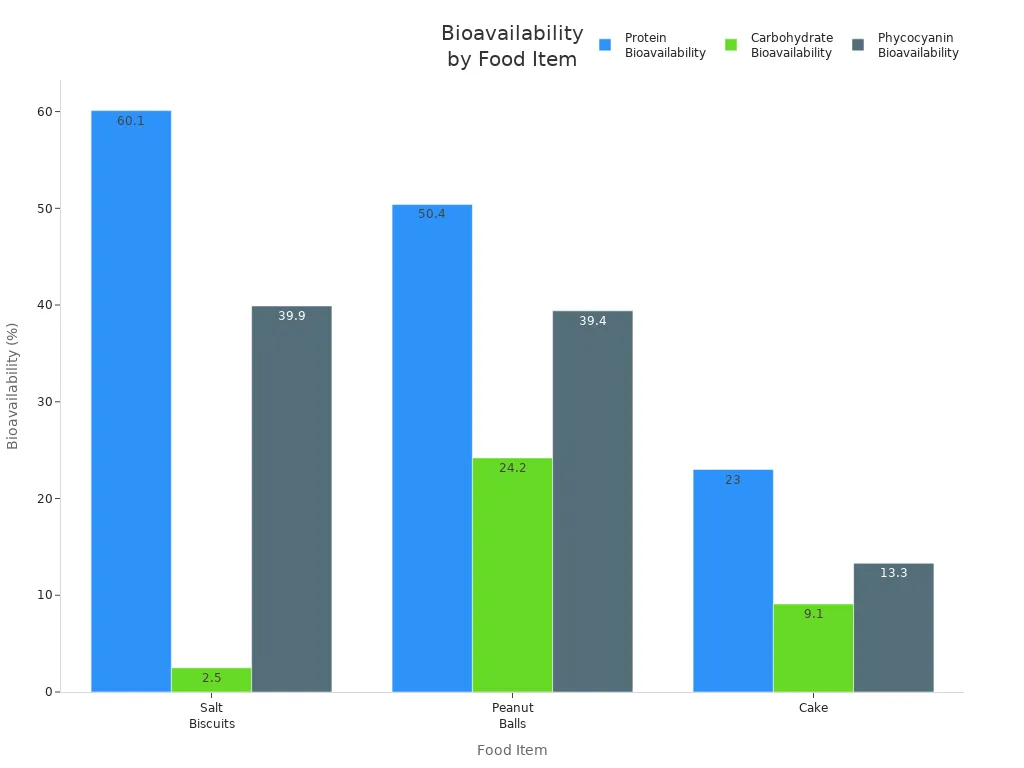
When you eat microalgae foods, you get more than just protein. You also get antioxidants and other nutrients. Microalgae foods help you eat better and make your meals look colorful. Phycocyanin is safe in food because the FDA and other groups say it is okay as a color and supplement.
Note: Some people may get an upset stomach, headache, or skin problems from microalgae supplements. Always pick high-quality products for your food.
There is a clear connection between spirulina and phycocyanin. Spirulina is full of protein, so it is a good food for your body. Phycocyanin is the blue part in spirulina and gives more health help. Both give you antioxidants, help lower swelling, and support your immune system.
Phycocyanin helps your body fight off sickness.
Spirulina gives you protein and other important nutrients.
You can mix spirulina into smoothies or snacks for extra protein.
Health Benefit | Description |
|---|---|
Protein Power | Spirulina has lots of protein to help your muscles and body. |
Antioxidant Support | Phycocyanin protects your cells and keeps you healthy. |
You can use spirulina and phycocyanin to get more protein and help your health every day.
FAQ
What makes phycocyanin special in spirulina?
Phycocyanin is what makes spirulina look blue. This pigment gives strong antioxidant and anti-inflammatory effects. It helps keep your cells safe and supports your immune system.
Can you take phycocyanin without spirulina?
Yes, you can buy phycocyanin as its own supplement. You get just the blue pigment if you want more antioxidants. This is good if you do not want the extra protein from spirulina.
Is spirulina safe for everyone?
Most people can use spirulina without problems. If you have allergies or health issues, ask your doctor first. Some people might get a mild upset stomach.
How do you use spirulina or phycocyanin in food?
You can add spirulina powder to smoothies, yogurt, or snacks. Phycocyanin is a natural blue color for drinks and desserts. Both can make your food healthier and more colorful.
Does spirulina have more benefits than phycocyanin alone?
Whole spirulina gives you more nutrients like protein, vitamins, and minerals. Phycocyanin gives extra antioxidant support. Using both together gives you the best health boost.