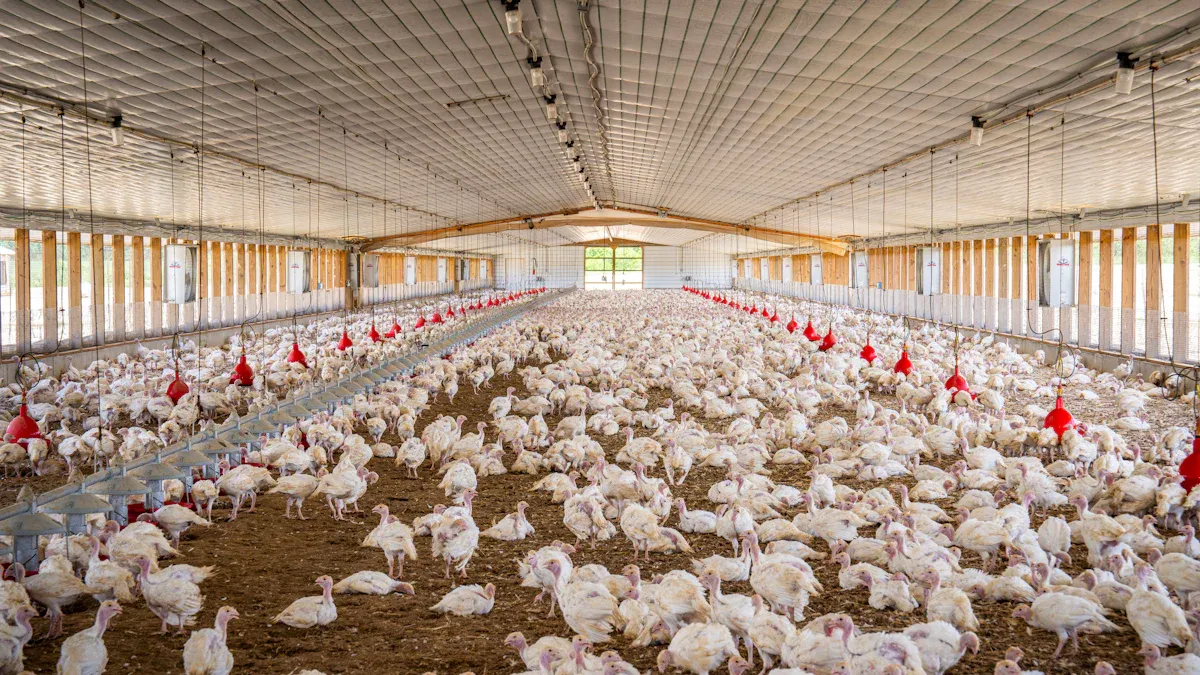
You can help broiler chickens grow bigger by adding L-Lysine and DL-Methionine to their food. These amino acids are important for making protein, building muscles, and keeping chickens healthy. When you put these nutrients in their feed, chickens can get heavier and do better overall.
Studies show that more lysine and methionine in chicken diets help them grow faster and stay healthier, especially when they are stressed.
Key Takeaways
-
Giving the right amounts of L-Lysine and DL-Methionine in chicken feed helps broilers grow faster. It also helps them build strong muscles and stay healthy.
-
When amino acid levels are balanced, chickens use their food better. This means farmers save money on feed costs.
-
Crystalline L-Lysine and DL-Methionine are easy to add to feed. They let farmers control nutrient amounts for the best growth.
-
Too much L-Lysine or DL-Methionine can make chickens eat less. It can also slow their growth. So, it is important to follow the dosage rules.
-
Using both amino acids together helps chickens grow better muscles, feathers, and bones. This makes chickens stronger and more productive.
L-Lysine and DL-Methionine
Essential Amino Acids
L-lysine and methionine are very important for chickens. Chickens cannot make these amino acids by themselves. You must give them these nutrients in their food. Lysine helps chickens grow muscles and build strong bones. It also helps their immune system work better. Methionine is the first limiting amino acid in most chicken diets. It helps chickens make protein and repair their bodies. Methionine also helps feathers grow. Both l-lysine and methionine help chickens use protein to grow and stay healthy.
If you add enough lysine and methionine to chicken feed, they use protein better. Not enough lysine can make chickens grow slowly and have weak bones. They might get sick more often too. Methionine helps protect chickens from heat stress. It also helps keep their liver healthy. When you balance these amino acids, chickens grow better and stay healthier. They also use their food more efficiently.
Tip: Using encapsulated lysine can help control how lysine is released in the digestive system. This makes it work better for your chickens.
Sources and Forms
L-lysine and methionine come from natural and synthetic sources. Natural sources are fish meal and corn gluten meal. Sometimes these do not give enough amino acids for chickens. Many farmers use crystalline amino acids in chicken feed. Crystalline l-lysine and crystalline methionine are pure forms. You add them straight to the feed. These supplements help you give chickens the exact amount they need.
Methionine is often added as crystalline DL-methionine. DL-methionine is a mix of two forms. Chickens can change the D-form into the active L-form. DL-methionine works well in chicken feed. Crystalline methionine is usually a white powder. You should keep it in a dry and cool place. This keeps it fresh and stable. Crystalline l-lysine is also a powder. It is easy to mix into chicken feed. Using these forms lets you lower protein in the diet. This can help save money and reduce waste.
|
Source Type |
L-Lysine (Crystalline) |
DL-Methionine (Crystalline) |
|---|---|---|
|
Natural Ingredients |
Fish meal, corn gluten meal |
Fish meal, sesame hulls |
|
Synthetic Additives |
Crystalline l-lysine |
Crystalline DL-methionine |
|
Feed Use |
Direct diet inclusion |
Direct diet inclusion |
You should always check lysine and methionine levels in chicken feed. This helps chickens grow well and stay healthy.
Growth Performance of Broilers
L-Lysine in Growth Performance
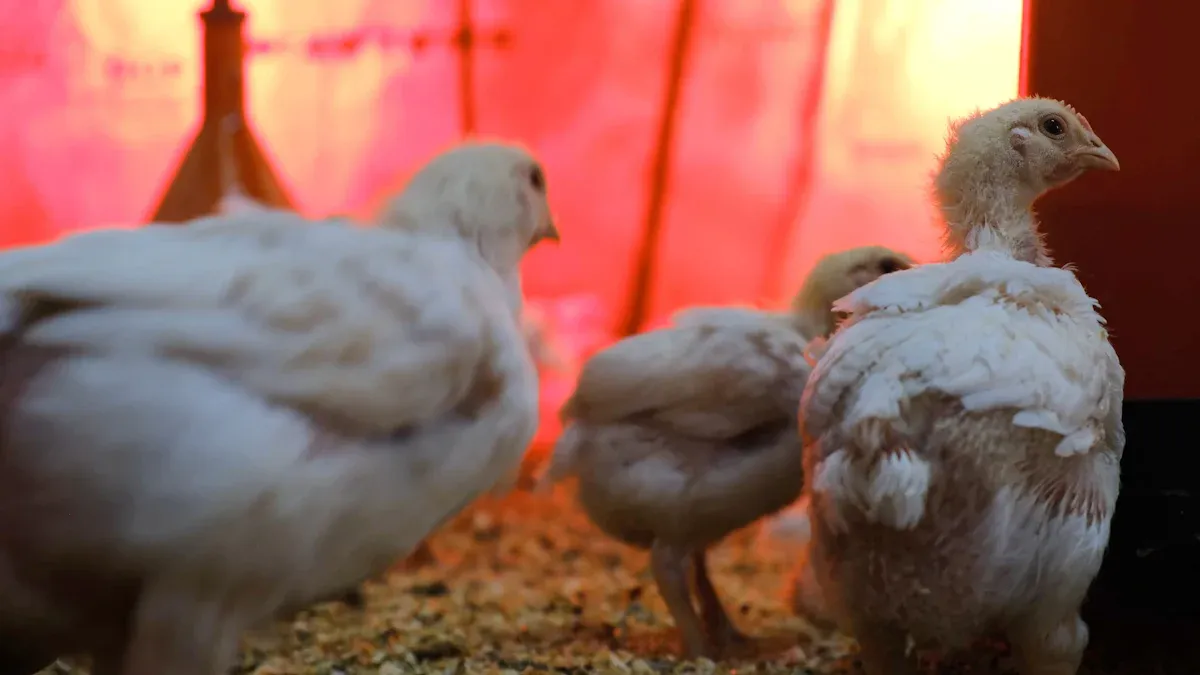
Adding l-lysine to chicken feed helps broilers grow faster. L-lysine is important for building muscle and using protein well. When chickens get enough lysine, they gain weight quickly. Their feed conversion ratio also gets better. Studies show that giving 1.2% to 1.5% lysine helps chickens grow more and use food better. If you raise lysine from 53% to 78% of methionine levels, chickens eat more and gain more weight. Their feed efficiency improves too.
Giving too much lysine does not always help chickens. If you go above the recommended amount, chickens may not grow more. Sometimes, too much lysine makes chickens eat less. Their feed conversion ratio can get worse. The best results come when lysine is at or just above NRC recommendations. New chicken breeds often need more lysine than older ones. You should change lysine amounts based on your chickens’ age and type.
-
Chickens fed 0.75% lysine have the most weight gain.
-
They also have the best feed conversion ratio.
-
More lysine, like 1.00% or 1.25%, does not help growth.
-
It can lower profit.
-
Less lysine, like 0.25% or 0.50%, means less weight gain.
-
Profits are lower too.
-
Lysine works best during finishing and stress times.
Balanced lysine helps chickens grow strong and use protein well. It also improves their performance. Research shows lysine does not change carcass yield or breast meat yield. Adding more lysine does not change the percentage of meat. You should focus on the best lysine level for growth, not for changing meat traits.
DL-Methionine and Broiler Performance
DL-methionine is another important amino acid for broilers. Adding DL-methionine helps chickens use protein better. It supports feather and tissue growth. DL-methionine improves feed conversion ratio. Chickens need less food to gain weight. Studies show DL-methionine works almost as well as L-methionine. L-methionine may work a little better for young chicks. DL-methionine is a good choice for most broiler diets.
|
Parameter |
DL-Methionine vs L-Methionine Effect on FCR |
|---|---|
|
Relative efficacy (linear model) |
DL-Met is 95.63% as effective as L-Met (P < 0.01) |
|
Relative efficacy (exponential model) |
DL-Met is 76.57% as effective as L-Met (P = 0.09) |
|
Average FCR values |
L-Met: 1.71 g/g (lower FCR, better) vs DL-Met: 1.74 g/g |
|
Correlation with FCR |
Negative correlation for both DL-Met and L-Met (-0.34, P < 0.01), indicating increased supplementation reduces FCR |
|
Conclusion |
DL-Met improves FCR but less effectively than L-Met |
Both types of methionine help chickens use food better and grow faster. L-methionine works best in the first three weeks after hatching. DL-methionine is more stable when making feed. It is used a lot in big feed mills. Both help chickens make protein, grow feathers, and stay healthy.
Farmers see better growth and feed conversion when they use both l-lysine and DL-methionine. Chickens also weigh more. The table below shows how more supplements help chickens:
|
Supplementation Level (gm/50kg feed) |
Feed Consumption (g/bird) |
Water Intake |
Live Body Weight (g/bird) |
Feed Conversion Ratio (FCR) |
|---|---|---|---|---|
|
0 (Control) |
Lowest |
Lowest |
1922.20 |
2.00 |
|
40 |
Increased |
Increased |
2009.00 |
1.99 |
|
80 |
Higher |
Higher |
2094.50 |
1.97 |
|
120 |
Highest |
Highest |
2301.60 |
1.87 |
More amino acids in the feed make chickens eat more. They drink more water and gain more weight. Their feed conversion ratio gets better. Chickens grow faster and use food better.

Note: L-lysine and DL-methionine help chickens grow and use food better. They do not change carcass yield. Even with more supplements, the percentage of meat stays the same.
Using crystalline l-lysine and DL-methionine helps chickens reach their best growth. It also helps them use protein and food better. Balanced protein and amino acids help broilers grow well. This gives you the best results in your chicken farm.
Effectiveness Comparison
Bioavailability
You want your broilers to get the most from their food. Bioavailability means how well their bodies take in nutrients. L-Lysine and DL-Methionine help chickens build protein and grow. Adding these amino acids helps broilers use protein better. The small intestine is where the body absorbs these nutrients. Special transport systems move them into the blood.
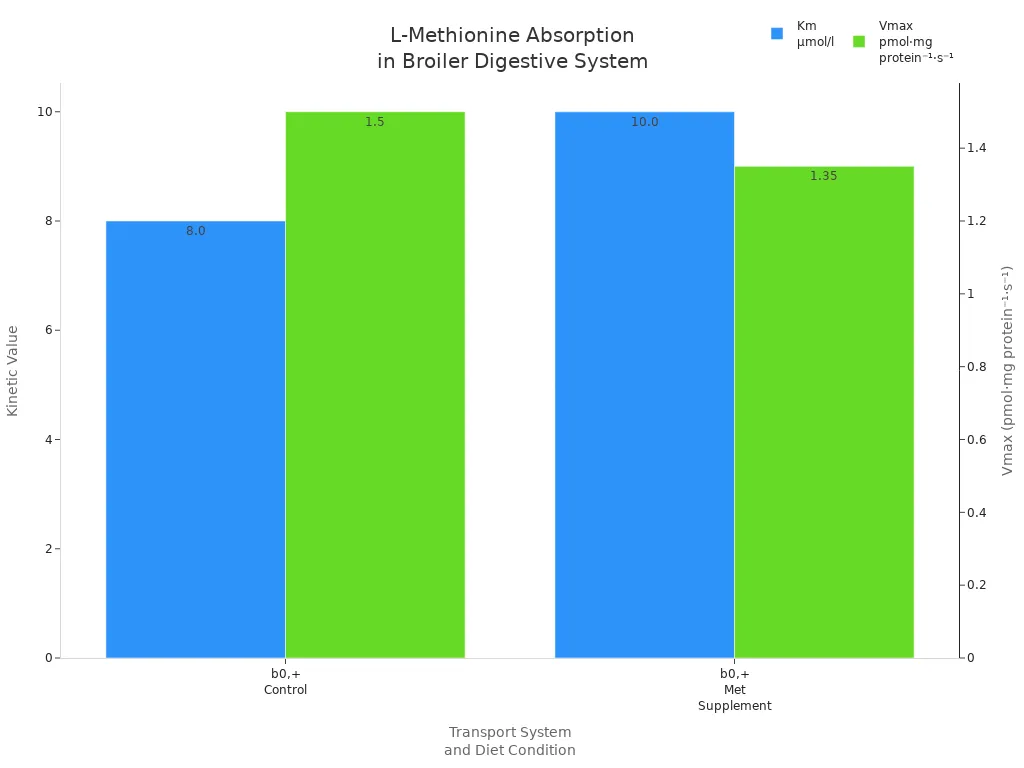
Researchers found that methionine in the diet can change how much lysine and methionine chickens absorb. The y+m transport system moves both amino acids in the intestine. If you add more methionine, this system slows down. The highest amount (Vmax) that can be absorbed drops by about 26-30% for methionine and 19-28% for lysine. The affinity (Km) stays the same, so the body still knows the amino acids. The b0,+ system does not change much with more methionine.
Here is a table that shows how absorption changes with different diets:
|
Transport System |
Amino Acid |
Diet Condition |
Km (μmol/l) |
Vmax (pmol·mg protein⁻¹·s⁻¹) |
Effect of Methionine Supplementation |
|---|---|---|---|---|---|
|
b0,+ |
L-Methionine |
Control |
8.0 ± 2.0 |
1.5 ± 0.03 |
No significant change |
|
b0,+ |
L-Methionine |
Met Supplement |
10 ± 3.0 |
1.35 ± 0.21 |
No significant change |
|
y+m |
L-Methionine |
Control |
N/A |
Reduced by ~26-30% with Met |
Vmax decreased, Km unchanged |
|
y+m |
L-Lysine |
Control |
N/A |
Reduced by 19-28% with Met |
Vmax decreased, Km unchanged |
Even with these changes, both L-Lysine and DL-Methionine are still easy for chickens to use. Crystalline forms let you give the exact amount needed. This helps chickens use protein better and grow faster. When you balance these nutrients, broilers grow quickly and use their feed well.
Dosage and Economic Efficiency
Picking the right amount of L-Lysine and DL-Methionine is important. It helps broilers grow well and saves money. Too little means broilers will not grow as much. Too much wastes money and can hurt growth. You need to find the best amount for each amino acid.
Studies show the best DL-Methionine level is 1 to 2 grams per kilogram of feed. At 1 g/kg, broilers reach their target weight two days sooner. Feed conversion ratio and daily gain get better too. At 2 g/kg, feed efficiency and meat yield are the best. For L-Lysine, most diets have about 2.8 g/kg. This amount helps chickens build muscle and protein.
|
Nutrient |
Dosage / Level |
Effect on Broiler Growth Performance |
|---|---|---|
|
DL-Methionine (DL-MET) |
0 g/kg feed |
Slowest growth; worst feed conversion ratio; lower average daily gain; reduced breast fillet and carcass yield |
|
DL-Methionine (DL-MET) |
0.5 g/kg feed |
Improved body weight compared to 0 g/kg; better FCR than no MET |
|
DL-Methionine (DL-MET) |
1 g/kg feed |
Achieved target weight 2 days earlier; better FCR and ADG; higher meat yield |
|
DL-Methionine (DL-MET) |
2 g/kg feed |
Similar benefits as 1 g/kg; best feed efficiency and meat yield |
|
Regulatory limits (USDA) |
~1 to 1.5 g/kg feed |
Maximum allowed synthetic DL-MET supplementation in organic diets |
|
L-Lysine HCl |
2.8 g/kg in basal diet |
Included in basal diet; supports protein synthesis and growth |
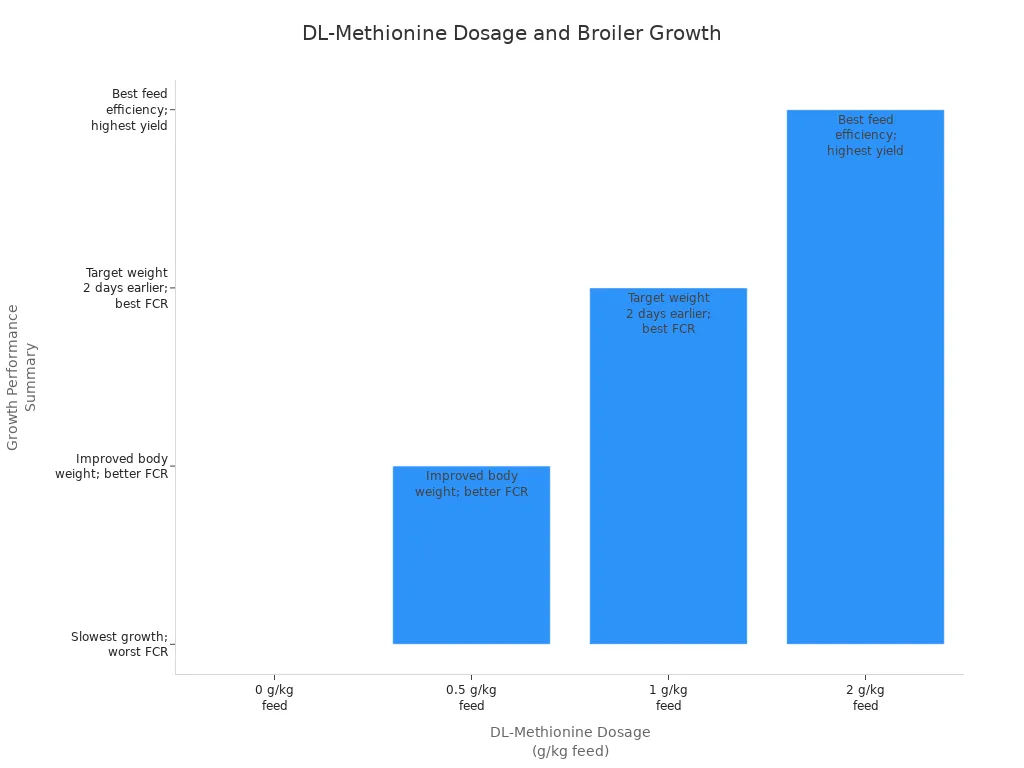
You should also think about saving money. Crystalline amino acids let you use less protein in the feed. This lowers feed costs and cuts down on waste. You can use less soybean meal or fish meal but still meet your broilers’ needs. Encapsulated lysine and methionine help you fine-tune the diet. These forms release slowly in the gut, so you may use less and still get good results.
Tip: Always balance amino acid ratios in the diet. Methionine plus cystine should be about 60% of lysine levels. This helps with protein use and growth.
When making feed, remember these points:
-
Balance amino acid ratios, especially lysine with methionine plus cystine, for best protein use.
-
Do not use too much. Too much lysine or methionine can hurt growth and waste money.
-
Use encapsulated forms if you want better use and less waste.
-
Methionine helps make other important compounds like glutathione and taurine.
-
Check serum urate levels to see how well broilers use amino acids.
-
Try phase feeding. Change the diet as broilers grow for better results and lower costs.
-
Use good ingredients and smart feed software for the best results.
You can help broilers grow, gain weight, and have better meat by using the right amounts of L-Lysine and DL-Methionine. When you balance the diet, broilers reach their best growth and your farm does well.
Growth and Health Benefits
Protein Synthesis
When you add L-Lysine and DL-Methionine to feed, broilers build strong muscles. These amino acids help make protein in the body. Chickens need protein to grow, fix their bodies, and stay healthy. DL-Methionine works just like L-Methionine in chickens. You get the same muscle benefits without spending more money. Studies show DL-Methionine turns on genes that help muscles grow. It also changes how some genes work, so muscle protein builds up faster. Fast-growing broilers have more protein in their breast muscles because of this.
L-Lysine and DL-Methionine together help chickens use food better and gain weight. Broilers get more muscle and better carcass yield. Even if blood protein does not change much, muscles still have more protein. This means chickens use their food better to grow muscle.
|
Aspect |
Effect of DL-Methionine Supplementation in Broiler Muscle Tissue |
|---|---|
|
Muscle-building genes work harder in fast-growing broilers |
|
|
Protein synthesis pathway |
ERK and mTOR signals help make more protein |
|
Muscle protein accretion |
Fast-growing broilers build more muscle protein |
Note: Balancing these amino acids helps broilers use protein well and grow healthy muscles.
Feather and Bone Development
Adding L-Lysine and DL-Methionine helps feathers and bones grow strong. These nutrients help broilers get more calcium and phosphorus. These minerals are needed for strong bones. Broilers with more L-Lysine and DL-Methionine have longer, heavier bones. Their bones are stronger and break less often.
Broilers also grow better feathers with these amino acids. Methionine is very important for feather protein. When chickens get enough, their feathers are smooth and full. They peck each other less. This keeps the flock healthy and lowers stress.
|
Parameter |
Effect of Supplementation |
|---|---|
|
Bone mineral content |
More calcium and phosphorus in bones |
|
Bone strength indices |
Bones are longer, heavier, and stronger |
|
Feather quality |
Feathers grow better and chickens peck less |
You get the best growth, bone strength, and feather quality when both amino acids are balanced. Broilers become healthier, stronger, and more productive.
You can help broilers do better by giving the right amount of L-Lysine and DL-Methionine in their food. Chickens will grow faster, get stronger muscles, and use their food better. The table below shows how each amino acid helps chickens grow and stay healthy:
|
Aspect |
L-Methionine |
DL-Methionine |
|---|---|---|
|
Growth performance |
Superior |
Beneficial |
|
Metabolic role |
Direct |
Indirect |
|
Stability in diet |
Less stable |
More stable |
To get the best results:
-
Watch your chickens’ health and change their food if needed.
-
Give different feed at each stage for every broiler group.
-
Add probiotics and fiber to help their stomachs work well.
-
Check how fast your chickens grow to keep them healthy and strong.
FAQ
What is the best way to add L-Lysine and DL-Methionine to chicken feed?
You can mix crystalline L-Lysine and DL-Methionine directly into the feed. Use a scale for accuracy. Check the recommended dosage for your broiler’s age and type. This helps you avoid waste and supports healthy growth.
Can you use L-Lysine and DL-Methionine together?
Yes, you can use both together. They work best when balanced. L-Lysine builds muscle. DL-Methionine helps with feathers and bones. Using both gives your chickens better growth and health.
How do you know if chickens need more amino acids?
Watch for slow growth, weak bones, or poor feather quality. Chickens may eat less or look tired. You can test feed samples or check growth charts. Adjust the feed if you see these signs.
Are there risks if you add too much L-Lysine or DL-Methionine?
Too much can lower feed intake and slow growth. You may waste money. Always follow dosage guidelines. Check your chickens’ health and growth often.
Tip: Keep records of feed changes and chicken growth. This helps you spot problems early.